Thursday, 24 September 2020

List of Facebook Groups about the Parish of St Brelade

This is a work in progress. It does not include private groups which are not open to the general public.

Charities


Love Thy Neighbour Jersey

A Jersey registered charity (AJC membership no 426) providing care and support for the long term homeless, the poor and those in need in the community.

Clubs and Organisations

https://www.facebook.com/groups/SBBBOA

Jersey Astronomy Club
https://www.facebook.com/JerseyAstronomyClub
A club for all those interested in Astronomy. Club house: Les Creux.

School Alumni

Les Quennevais School
https://www.facebook.com/groups/2217426299
A Facebook group designed for all Ex-LQ students to catch up and remember the good old days at LQ School

Sporting Groups

St Brelade's FC

Boating

St. Brelades Bay Boat Owners Association
https://www.facebook.com/groups/SBBBOA/

Special Interest Groups

St Brelade Parishioners
https://www.facebook.com/groups/StBreladeParishioners
A community group for the Parish of St. Brelade in the Island of Jersey - For friendly discussion, news, events, issues, etc.
Individual Groups

History

St. Brelade's Camping Park
https://www.facebook.com/groups/StBreladeCampingPark
St. Brelade's Camping Park was Jersey's top 5 Star campsite which ran for 30 years until it closed in the mid-90's. A group for comments, memories, photos or video.

Groups not easily classified under above classes.

Saint Brélade buy and sell
https://www.facebook.com/groups/578141209802026
This is a group for people who live in Saint Brélade to sell their unwanted items, only people who live in the parish to advertise things for sale but open to all who wish to buy.


Saturday, 19 September 2020

Persephone’s Lament


In Greek mythology, Persephone is the Queen of the Underworld. She was the daughter of Demeter, who is the Goddess of fertility and bountiful harvests. Persephone’s story is used to explain the shifting of seasons and is known all over the world as one of the most famous Greek goddesses.

The story says that Persephone often enjoyed playing with the Naiads, who were freshwater-dwelling nymphs. One day, while Demeter was harvesting her bounty, and the water nymphs were distracted, Persephone wandered away to pick a flower. When she plucked the flower from the earth, the ground split open beneath her and Hades came thundering through with his chariot and horses. The capture happened so swiftly that no one saw where she went.

When Demeter discovered her daughter’s whereabouts, she demanded that Hades return her. However, while she was in the underworld, Persephone consumed six pomegranate seeds. Some say she was forced or tricked, while others speculate that she willingly ate them so she could safely return to her husband each year. In Greek mythology, when someone accepts food from a captor, they are bound to return to them.

The spring and summer is when Persephone is in the care of her mother. In her joy, Demeter makes flowers bloom and crops flourish. In the autumn, Persephone returns to the underworld, and Demeter lets the world die back in mourning, once more awaiting her daughter’s springtime arrival.

I've taken  the story of Persephone and reworked it as a psychological piece, so that it is time for Persephone to returns to the underworld, but this in fact is more like seasonal affective disorder, the depression that comes with the coming autumn and winter and shortening days. The shadowy image of "the stalker" could be internal, as much as it could be an M.R. James kind of ghostly figure.

Persephone’s Lament

Days are shorter, and I must leave the light
Descending into the darkness of the night
I know the shadow comes to enfold me
And deep, deep underground I will be
Already leaves turning brown and fall
The birds migrate, with farewell call
Those autumn pastimes: my goodbye
As storm clouds race across the sky
Here is harvest home, pumpkin pie
Nuts, apples, grapes, berries picking
Grain threshing, dancing and feasting
Bonfire burning leaves, cider drinking
Conker playing, but my world shrinking
As the earth begins again to slowly die
And now come cold winds, over land
The holidaymakers have fled the sand
Beaches empty, just the dog walker
In the mist, in the distance, my stalker
Coming my way, running, rag and bone
As the tide crashes down upon the stone
And there is no escape, no place to flee
As the Grey King comes to capture me

Friday, 18 September 2020

Gas in Jersey - Part 6

LPG Reforming Plant with Butane Spheres, 1967


Continuing with a "A Brief History Of The Jersey Gas Company" compiled by Roger Long from research by Robin S Cox and Rene H Le Vaillant. The concluding part!

Other Parts:
https://tonymusings.blogspot.com/2020/09/gas-in-jersey-part-5.html

THE OCCUPATION AND AFTER

The German Occupation from 1940 to 1945 tested the ingenuity and resourcefulness of the Company’: workforce to the full. Shortages of raw materials and spare parts created ever-increasing  difficulties and in September 1944 production of gas ceased. The gas-holders were, however, filled and this gas was used as fuel for communal soup kitchens during the winter of 1944-5. As soon as a supply of coal was assured immediately after the Liberation. a stock of coke, which had been carefully concealed from the occupation authorities. was unearthed and used to commence heating the retorts.

 Consumption grew rapidly with the return of the evacuees and the post-war expansion of tourism. New plant was sorely needed to replace the existing over- loaded and outworn plant, and construction of a Vertical Retort House was begun in January 1952 and completed in March 1954. A further period of expansion followed and by 1964 the annual gas output had risen to nearly 700 million cubic feet. The Company now had over 130 miles of main between Gorey and La Corbiére making gas available to about 85% of the population.

A number of factors, not least of which was the rapidly rising price of coal, led to a search for an alternative raw material. As catalytic reforming of Liquid Petroleum Gases had by this time become an established means of gas production construction of a Butane Reforming Plant was undertaken, and early in 1967 a gradual change over from coal gas began. On 4th December 1968 the last of the old retorts was shut down concluding a period of 138 years of coal gas production.

Mixing room of the Butane / Air Plant. 1977


The most traumatic period in the Company's recent history arose from the decision, imposed upon the Board by several considerations, to convert from what was called Town Gas to a butane fair mixture. In addition to building new gas making plant a costly programme for converting every appliance in the island to the new gas was undertaken over a comparatively short period. This exercise, although not without problems, was successfully completed in June 1977 and butane air is now well established.

The simplicity and smallness of the new gas-making plant, which produces gas at over 98% efficiency, has enabled the Company to place on the market a substantial area of its Tunnell Street property which was largely used for storing thousands of tons of coal and coke.

Since 1973 the twin pressures of rampant inflation and the need to conserve fossil fuel resources have put a brake on the expansion formerly enjoyed by all the energy-producing industries. Despite the public’: evident response to these forces the greatest daily output in the Company's history occurred on 18th January 1979. The 198l price of butane feedstock used to make gas is nearly fourteen times that paid for the first load in 1966, yet the average price of gas supplied has only increased by a factor of seven during the same period.

The rapidity of recent technological changes will surely be a warning to those who would forecast what the future holds, as the Jersey Gas Company enters the second half of its second hundred years. Nevertheless, the Company is already making plans for further technological developments and, with a record of service to the consumer which is second to none, faces the future with confidence.

Spiral-guided. 750,000 cubic feet gasholder
built on the St Saviour Road site in 1949.
It has now been demolished


Tuesday, 15 September 2020

How Freedom of Information Works


Request

How many swab tests were carried out during July and August, and what was the total cost of those tests?

Reply

Between 1 July and 31 July, 22,004 tests were carried out.  Most tests are processed by a company in England. This is completed under a contract, and therefore is commercially sensitive and costs are exempt from disclosure under Article 33 (b) of the Freedom of Information (Jersey) Law 2011.

My comment

I am at a loss to understand how you could not answer the request for costs when today the BBC published details of the costs made public. Perhaps you could explain this rather strange discrepancy, and why something can be commercial sensitive at one moment in time, and available about a week later? Does “commercially sensitive” in this context just mean “not available until the Government decides to make it public”.

BBC: Jersey's chief minister has revealed the island's government spent almost £5m on its Covid-19 testing regime in July and August.  The sum of £4.8m paid for both on-island testing and swabs at the harbour and airport.  It also went towards staff wages, as well as the cost of transporting swabs and having them processed.

Their reply:

Please accept our apologies for this oversight. The responding team have noted that they had misinterpreted the question, and answered about test processing costs, rather than the total cost of the testing service.

The total direct cost of testing for July and August is c£4.8m. Between 1 July and 31 August 2020, 57,102 on-arrival tests had been undertaken, along with 10,851 tests for Islanders seeking healthcare and/or essential workers. 

We note that the disclosure log will be updated accordingly.

Friday, 11 September 2020

The Bringer of War


The Bringer of War

Look east to the planet, so glorious above
It’s Mars the Red Planet, I adore and love
I’ve waited so long, just counting the days
Now shining in splendour, now ready to praise

O tell of his might and sing of his grace
So perfectly in night sky, so red in deep space
As a god of the harvest, he makes the crops form
As god of the war, he calls forth the storm

The War of the Worlds, such stories recite
Of Martians in Tripods, of heat rays of light
They came to the hills, they descent to the plain
And red weed abounds and grows after rain

Poor creatures of dust, the Martians found frail
Our soldiers lie dead, the army does fail
But smallest of virus, bring Martians to end
They die of our colds, that small unseen friend

The War of Worlds ended, we once again love
And Mars is a dead planet, still shining above
But close to the earth now, with glory ablaze,
Red Planet so bright, we sing to your praise!

Gas in Jersey - Part 5


Continuing with a "A Brief History Of The Jersey Gas Company" compiled by Roger Long from research by Robin S Cox and Rene H Le Vaillant.

At a special general meeting in October 1909 it was reported that for some time the Company had been involved in preparing a Private Bill to be presented to the States in opposition to a proposed Projet de Loi which called for “Public control of Gas, Water and Electric undertakings.“ Among other steps taken an independent valuation and assessment of the Company was obtained. as a result of which the Board congratulated Joseph and Harry Morris, they being satisfied “...that the Jersey Gas Light Company works are in a condition equal If not superior to any works of the same size in the United Kingdom."

The States passed the Bill for the Control of Public Companies in March 1910. The Company thereupon successfully lodged a petition with His Majesty's Privy Council “. . .praying that the said Bill be not sanctioned." However the Company’: position as a public utility was eventually regularised in 1918 by incorporation by an Act of the States of Jersey as the Jersey Gas Light Company Limited. As well as providing safeguards for the Company, control of gas quality and pressure was made statutory, and thereafter the tariff was based on British Thermal Units sold rather than gas volume.

Only one serious dispute has marred industrial relations within the Company. This led to the workmen withdrawing their labour on 1st November 1921. But they ensured the safety of the gas-making plant throughout the strike and work was resumed 18 days later.

During 1923 plans were put forward for a high-pressure gas distribution system to serve the east of the island. Construction was started the following year and the first gas entered the system on 20th December 1924. This and other extensions led to increased demand which was met by the installation of a Water Gas Plant in 1926. The only other interruption to gas production apart from the wartime occupation was in 1931, when exceptional rainfall on 24th August caused Le Fauxbie brook to flood into the works which was put out of action for a short while. 

Sunday, 6 September 2020

Academic Albatross: Hitler Diaries and Gospel of Jesus Wife


“I regret that the normal method of historical verification has been sacrificed to the perhaps necessary requirements of a journalistic scoop.” (Hugh Trevor-Roper on the "Hitler Diaries" saga)

Following Mark Goodacre's excellent series on the Gospel of Jesus Wife, presented by Karen King to the world in 2012, I decided to compare how it failed to learn the lessons from another academic being duped by fakers. Mark's blog is at:

https://ntweblog.blogspot.com/2020/08/interview-with-ariel-sabar-on-nt-pod.html

What is The Gospel of Jesus Wife?

The Gospel of Jesus' Wife is a papyrus fragment with Coptic text that includes the words, "Jesus said to them, 'my wife...'". The text received widespread attention when first publicized in 2012 for the implication that some early Christians believed that Jesus was married. The title was given to it by Karen King - it is not named. It is about the size of a credit card, so it really is fragmentary.

The Hitler Diaries

One of the most notorious cases of an academic being taken in by a fake was the case was the Hitler diaries.

The New Yorker gives a concise summary of the emergence of the Hitler diaries:

On April 25, 1983, Stern magazine—the German answer to Life—held a press conference to make a sensational announcement: their star reporter had discovered a trove of Hitler’s personal diaries, lost since a plane crash in 1945. Now Stern would begin publishing what he’d found.

Involved in this was Gerd Heidemann, a journalist in the contemporary history section of Stern, and  Konrad Kujau, a small-time crook and prolific forger.

As the New Yorker notes:

While Heidemann continued to buy volumes (there were supposedly twenty-seven of them), two historians began a nearly-two-year-long project of verifying the diaries. (Unfortunately, they failed to notice that the history book they were using to check the diaries’ facts—Max Domarus’s anthology, “Hitler: Speeches and Proclamations 1932-1945—The Chronicle of a Dictatorship”—was the same one Kujau had copied swaths of information from, word for word.)

And there were even more obvious clues, had everyone not been so excited about the find:

Mistaking the Gothic “F” for an “A,” Kujau had accidentally labeled each notebook’s black cover “FH” instead of “AH,” a detail that failed to put anyone on alert

The Sunday Times turned to one of the greatest historians of his generation: Professor Hugh Trevor-Roper, author of The Last Days of Hitler, and Hitler’s Table Talk, now elevated to the title of Lord Dacre of Glanton.

As the Guardian noted:

Trevor-Roper didn’t merely pronounce the Hitler diaries genuine. He also declared them “the most important historical discovery of the decade.” He maintained that they were, in an odd comparison, “a scoop of Watergate proportions.”

But he began to get doubts:

Lord Dacre, better known as Hugh Trevor-Roper, the historian and director of Times Newspapers, who originally said that the diaries were authentic and then backtracked, commented last night: “I don’t want to blame anyone. It is my fault."

“I should have refused to give an opinion so soon. I have been convinced for some time that they are forgeries.”

The fallout was significant. As the Independent noted:

The historian Trevor-Roper was left badly damaged. For all his glorious academic achievements, it was the Hitler Diaries for which he was remembered. When he died in 2003, the headline on The Independent’s obituary called him “The Hitler Diaries historian”.

So why did it happen? Why were so many historians and journalists initially eager to pronounce the diaries as genuine?

Giovanni di Lorenzo suggested that it was part of the spirit of that age:

“Today, if a colleague came into the newsroom and said, ‘I just bought the Friedrich the Second’s crutches, from Goering’s collection,’ I would advise him to seek psychological help. But here, you read, they went on a tour of Heidemann’s collection, and came back enraptured... But what you feel, reading this text, is that there was a fascination with this time period, and with this ‘Adolf Hitler’ who played a role in all their childhoods. This is a fascination that is unimaginable in my generation.”

In other words, there was a psychological and cultural predisposition for the experts to pronounce the diaries authentic. No one initially dug deeper either into provenance (which is when the whole hoax was finally exposed) or even into the obvious copying from other sources within the diary itself. 

There was such an expectation to believe them genuine that, as Hugh Trevor-Roper regretfully noted in hindsight: “I regret that the normal method of historical verification has been sacrificed to the perhaps necessary requirements of a journalistic scoop.”

The Gospel of Jesus Wife.

Reading and listening to Mark Goodacre's podcasts, and reading the linked material, it seems as if something very similar had happened there, this "fascination with this time period". Obviously, with such a document much better prepared that the diaries - using old papyrus to present the material as genuine, it took longer, but the resulting investigation which proved it a fake followed similar lines (1) an examination of the text itself, and locating it as copying from a modern print of a Coptic text and (2) a detailed investigation into provenance.

There seems to have been an untimely rush to get the story out, and "The Gospel of Jesus Wife" was certainly a title designed for journalists rather than academics, and a world which had eagerly devoured "The Da Vinci Code", as well as its predecessor "The Holy Blood and the Holy Grail". Like "The Hitler Diaries", this resonated with the zeitgeist of our times in which Mary Magdalene is often seen to have a special and intimate relationship with Jesus. 

[In passing, I would say it is a shame that the other women in the New Testament are so often marginalised as a result of this focus on Mary Magdalene. "The Women around Jesus" by Elisabeth Moltmann-Wendel [late wife of theologian Jurgen Moltmann] stands apart in looking at all of those.]

It is not the only occasion in which academia has gone for the snappy title aimed less at colleagues, but more at the public - I remember "The Myth of God Incarnate" as another example. A perusal of the book elicited the simple fact that different contributors had different understandings of what myth meant, and sometimes the same contributor used it differently in the same article. And it came out at a time when secularism seemed especially on the rise (as Harvey Cox's "The Secular City" suggested); again in keeping with the zeitgeist.

And like the Hitler diaries, matters of provenance took a back seat, and even carbon dating came later in the day - after the press announcement. Like Hugh Trevor-Roper with the diaries, Karen King seems to have initially been too eager to accept the fragment as genuine.

After all, she said initially the fragment dated to the 4th century but could be a copy of an early gospel from the 2nd century. But in fact one of the carbon-dating tests indicated that the papyrus went back olny as far as somewhere between the year 659 and 869 , much later than her estimate. And she seemed to have overlooked the fact that - as The Atlantic magazine pointed out -forgers have access to genuinely ancient papyrus: blank pieces are easily purchasable on the antiquities market, as are papyri containing unremarkable texts from which the ink can be scraped off.

And for four years, she defended the so-called “Gospel of Jesus’s Wife” against scholars who argued it was a forgery. But finally she conceded that the papyrus—which she introduced to the world in 2012—is a probable fake.

A Late Apology

Karen King is a highly respected specialist in early Christianity whose work focuses on the Gnostics. But I can't help thinking that, like poor Hugh Trevor-Roper, this hoax will loom large in any future obituary, especially as unlike Trevor-Roper, she stoutly defended the papyrus for four years, where he began to have doubts within a very short space of time. 

History Magazine reported on her grudging acceptance of the hoax:

“I don’t see anything to retract,” King told the Boston Globe, noting that her research paper had always allowed for the possibility of forgery. “I have always thought of scholarship as a conversation. So you put out your best thoughts, and then people…bring in new ideas or evidence. You go on.” She did tell the newspaper that the experience had taught her one thing. “I would never agree to do an anonymous thing again. Lesson learned.”

However, in contrast, Trevor-Roper actually admitted his mistake over the diaries in a much less strident manner:

"I believe that I too was badly treated, both by Stern, which misled me with false evidence of fact (which I could not doubt unless I was to accuse them of bad faith) and, to some extent, by The Times, which did not allow me the conditions which I had at first been promised to check the material (i.e. a typed transcript of the German text on which I was to make a written report). However, I have refused to make any complaint or excuse on these grounds, for I recognise that I should have been firm and have refused to commit myself in the circumstances which actually obtained. So, when I first doubted the authenticity of the material, I decided to take the whole blame on myself-and I must admit that The Times and the Sunday Times were very happy to place it there."

The Failure of the Scientific Method

Karl Popper said of the scientific method, that you start with a hypothesis and you try to falsify it. The hypothesis was that the documents were genuine, but unfortunately there was not enough work done on trying to subject it to critical scrutiny.

Ariel Sabar notes that when she revealed her fragment, King refused to allow a (negative) response to be published alongside her article in Harvard Theological Review and that when she released her story to the press she did so on the condition that they only speak to pre-approved scholars

The same mistake can be seen in the methodology of the translation of the Gospel of Judas, which appears to have made significant errors, changing the meaning. April D. Deconick showed in detail how this changed the whole understanding of the text commented:

"National Geographic wanted an exclusive. So it required its scholars to sign nondisclosure statements, to not discuss the text with other experts before publication. The best scholarship is done when life-sized photos of each page of a new manuscript are published before a translation, allowing experts worldwide to share information as they independently work through the text."

That happened later with the Gospel of Jesus Wife, and at least the photos were available online and in high definition for scholars to work on. The working together of different scholars to track down major problems with its authenticity shows, I think, that an open scientific method in historical study works extremely well - but also that when it is curtailed, all kinds of mistakes are made. 

To give an analogy, it is like proof reading - one person can easily misread a text, but more sets of eyes there are, the greater the chance of catching any misprint. Equally if something is authentic, a robust critical scrutiny is more likely to establish that than trying to restrict scrutiny to a narrower field of views, especially if chosen to defray criticism. There really is a wisdom of the crowd, if it is a clever and diverse crowd.

The Academic Albatross

Like Michael Fish's notorious weather forecast, when academics make some mistakes, they are doomed to have those follow them, like an albatross hung around their neck. Both Hugh Trevor-Roper and Karen King seem to have rushed into authentication, without enough care, without making sure that the documents could not be forgeries.

As Ariel Sabar, author of Veritas: A Harvard Professor, A Con Man and the Gospel of Jesus's Wife, says: “In speaking to scholars, my sense is that her reputation has taken a hit"

See also:
https://www.theatlantic.com/magazine/archive/2014/12/the-curious-case-of-jesuss-wife/382227
https://nypost.com/2020/08/15/how-a-mystery-note-proving-jesus-was-wed-led-to-harvard-profs-disgrace/
https://www.nytimes.com/2007/12/02/opinion/02iht-edeconick.1.8558749.html

Postscript:

While Hugh Trevor-Roper will be forever overshadowed by "The Hitler Diaries", in terms of a contemporary British conman he appears to have been remarkably more critical. The take of how he came to doubt and then pursue British impostor Robert Parkin Peters is outlined in "The Professor and the Parson: A Story of Desire, Deceit, and Defrocking" by Adam Sisman which I would highly recommend.

Summary at: https://www.nytimes.com/2020/02/14/books/review/professor-parson-adam-sisman.html

Saturday, 5 September 2020

Imprisonment


Imprisonment

In prison, waiting for release
Awaiting the sentence to come
The nightmare that will not cease
The endless beating of a drum

The day of judgement, time to tell
The scaffold prepared, all ready now
It is like bewitched by wicked spell
Before the breaking of the bough

I cry: Is there in Gilead, no balm?
I see the wooden block in place
Outside, there is a deadly calm
Awaiting ending of this race

Iron bars do not a prison make
But fear still says: awake, awake!

Friday, 4 September 2020

Gas in Jersey - Part 4


Continuing with a "A Brief History Of The Jersey Gas Company" compiled by Roger Long from research by Robin S Cox and Rene H Le Vaillant. 

A NEW START

In his English affairs Thomas Edge became bankrupt and on 30th September 1850 a receiver sold the St Helier gasworks to local trustees. This led to the formation of the Jersey Gas Light Company, of which Elias Néel Junior was elected President, George Heller Horman Vice-President, and John Gibaut Secretary. The other directors were Charles Fixott, Matthew Gallichan. George Gaudin and Thomas Anthoine; Clement Perchard was appointed Manager.

Local ownership resulted in a new confidence in gas and it at last became fashionable as a form of lighting in domestic properties. The Royal Court was lit and heated by gas and the newly-erected Victoria and Albert Piers were lit in 1857, the Markets in 1858 and the old Public Library in 1859. Extensions to the system were laid to Petit Bagot, Millbrook, St Lawrence's Valley and to Augrés.

Clement Perchard, the Manager, died in 1860 and on 23rd August the President. Elias Néel was appointed President and Manager. Subsequently a new hostility developed between the Company and the consumers and for the third time a rival gas company was promoted. During Clement Perchard's management the price had been reduced to 6s 6d a thousand cubic feet and the suggestion of a new company caused the directorate to drop the price to 6s 0d a thousand cubic feet. This was not good enough for the consumer who, by further agitation, obtained an instant reduction to 5s 0d.

As a result of this episode the duties of President and Manager were separated and Joseph Morris was brought from Guernsey to run the Company in December 1862.

In January 186l the Company bought more adjoining land on which to extend the works, in order to cater for the increased consumption created by the inauguration, on 24th June 1864, of the gas supply to St Aubin. In March 1867 the Company purchased the last house in Campbell Place (now 109 Bath Street) making them owners of the whole of the site between Gas Lane and Gas Place.

There followed a period of comparative stability and steady progress. A new office and the Company's first showrooms were opened on 31st May 1880, on the site of the present showrooms. This satisfactory situation did not prevent the Board keeping a wary eye on developments in other fields: “The question of electricity has been constantly under the attention of your Board, but its progress has not created any anxiety in their minds.”

Queen Victoria's Golden Jubilee celebrations were enhanced by the erection of 63,825 jets in ‘designs’ on a number of public and private buildings.

Harry Morris, a future manager, was appointed assistant to his father Joseph in September 1895. The following year the Board and shareholders presented Mr Morris Senior with an elaborate épergne mounted on a massive plinth of silver, suitably inscribed, in recognition of 34 years of service as Engineer and Manager.

A less cordial note was struck at about this time by the consumers in St Aubin, who petitioned the Company - unavailingly for a reduction in the price of gas from 3s 6d per 1000 cubic feet to 3s 0d as paid by Town consumers.

November 1893 saw the first mention of Mr Charles Robin's property in Tunnell Street, the site of the present works, and its purchase was completed by the following February. Substantial increases in output, which had quadrupled between 1862 and 1895, led to the decision to expand into larger premises, as a result of which construction of a completely new works on the Tunnell Street meadow was begun. It was reported during 1897 that progress on the new retort house was slower than expected and the first charging of the retorts was delayed until December 1899. Continued problems were encountered and it was February 1902 before the retorts in the old works could be finally shut down.

Wednesday, 2 September 2020

Singing and Coronavirus


BBC News

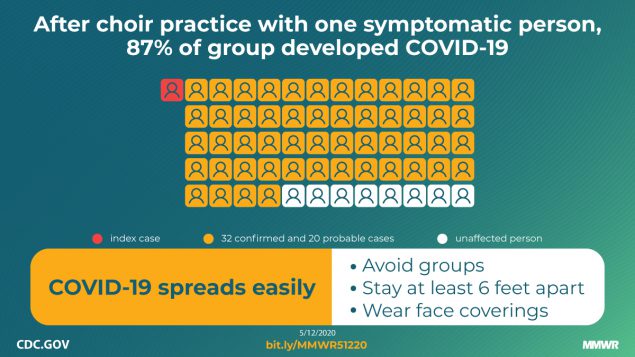
There are calls for Jersey's health authorities to ease restrictions that are stopping island choirs from singing together in person.

Under the current guidance, singing is not advised either inside or outside due to the risk of spreading coronavirus.

Nicki Kennedy, who set up a virtual choir during lockdown, is frustrated by the lack of clear guidance about when that might change, after ministers suggested the restrictions may be in place for the rest of the year.

Some good(ish) news on singing. A recent study (summary below) shows that soft singing (not loud) may have little more risk than talking – but do note that it has not yet been peer reviewed, and only applies to singing softly. It was also a highly controlled study with a number of individuals singing separately. Clearly more work needs to be done, and this is just a preliminary testing experiment.

“Speaking and singing show steep increases in mass concentration with increase in volume (spanning a factor of 20-30 across the dynamic range measured, p<1×10⁻⁵). At the quietest volume (50 to 60 dB), neither singing (p=0.19) or speaking (p=0.20) were significantly different to breathing. At the loudest volume (90 to 100 dB), a statistically significant difference (p<1×10⁻⁵) is observed between singing and speaking, but with singing only generating a factor of between 1.5 and 3.4 more aerosol mass. Guidelines should create recommendations based on the volume and duration of the vocalisation, the number of participants and the environment in which the activity occurs, rather than the type of vocalisation. Mitigations such as the use of amplification and increased attention to ventilation should be employed where practicable.”

It does NOT apply to choirs, as they state, group singing was not studied, and would probably be a greater risk. Other studies of infections (further below) confirm that choirs and group singing, as well as singing loudly, remains a risk.

Studies also suggest that ventilation helps, so soft singing outside is even less risky. But it does look hopeful for some future with singing, even if the Herald Angels may be rather muted this year.

The full article is at:

Comparing the Respirable Aerosol Concentrations and Particle Size Distributions Generated by Singing, Speaking and Breathing 

https://chemrxiv.org/articles/preprint/Comparing_the_Respirable_Aerosol_Concentrations_and_Particle_Size_Distributions_Generated_by_Singing_Speaking_and_Breathing/12789221

And it notes: “These are preliminary reports that have not been peer-reviewed. They should not be regarded as conclusive, guide clinical practice/health-related behavior, or be reported in news media as established information.”

Despite that, some rather misleading précis which omit that it is a preprint not peer reviewed have appeared. or put that just into one sentence, whereas it is extremely important in any scientific study.

A summary of the findings:

https://www.sciencefocus.com/news/spread-of-covid-19-doesnt-depend-on-what-you-sing-but-how-loud-you-sing-it/ 

Singing is no more risky than talking when its comes to the possibility of coronavirus transmission but it all depends on how loud a person is, scientists have said.

In a new study, which is yet to be peer-reviewed, researchers at the University of Bristol have found that speaking and singing generate similar amounts of aerosol droplets when the sound volumes are the same.

They found that higher volume was associated with an increase in aerosol mass in both speaking and singing, with the loudest level generating up to 30 times more aerosol mass than the lowest volume.

However, they said there were no significant differences in aerosol production between genders or among different genres of music such as choral, musical theatre, opera, jazz, gospel rock or pop.

As part of an ongoing research project, called Perform, the researchers looked at the amounts of aerosols and droplets generated by a large group of 25 professional performers that were up to 20 micrometres (0.02m) in diameter.

The singers performed a range of exercises including breathing, speaking, coughing, and singing at a hospital operating theatre with a “zero aerosol” background.

Dr Florence Gregson, a researcher at the University of Bristol and first author on study, said using this hospital setting setting meant “any aerosol we detected with our measurements, we could directly attribute only to what the singer had produced”.

The experiments included singing and speaking Happy Birthday at different sound levels, between the ranges of 50–60 decibels (dB), 70-80 dB and 90-100 dB.

At the loudest level, singing generated more aerosol particles than speaking but the researchers said that this difference was “very modest”.

Based on their findings, the researchers said ensuring adequate ventilation in the venue may be more important than restricting a specific activity.

Jonathan Reid, an expert in aerosol science at the University of Bristol and a corresponding author on the paper, said: “The study has shown the transmission of viruses in small aerosol particles generated when someone sings or speaks are equally possible with both activities generating similar numbers of particles.

“Our research has provided a rigorous scientific basis for COVID-19 recommendations for arts venues to operate safely for both the performers and audience by ensuring that spaces are appropriately ventilated to reduce the risk of airborne transmission.”

Dr Julian Tang, honorary associate professor in respiratory sciences at the University of Leicester, who was not involved in the study, said: 

Also, the study was performed on individual singers one at a time – when the particle profile was found to be similar to talking. The risk is amplified when a group of singers are singing together, eg singing to an audience, whether in churches or concert halls or theatres. "

“This may also affect the airflow dynamics of that air volume which may be more than the individual contributions from each singer via some complex resonant entrainment airflow dynamics that may propel these aerosols further. It is not comparable to the quiet breathing of the audience whose breathing will not be synchronised in a coordinated manner – like the exhalations of the choir – or talking to each other on a one-to-one basis.

“The risks should not be overly underestimated or played down because of this – we don’t want choir members getting infected and potentially dying from COVID-19 whilst doing what they love.”

He added: “It is a nice study but not exactly representative of the real whole choir dynamic which really needs further study to truly assess the risk of such large volume synchronised singing vocalisations/exhalations.”

This is a handy Q&A which gives details of how the study was done:

https://www.pri.org/stories/2020-08-13/choirs-age-coronavirus-new-study-looks-risks-singing

Also to note:

https://www.cdc.gov/mmwr/volumes/69/wr/mm6919e6.htm

Choir practice attendees had multiple opportunities for droplet transmission from close contact or fomite transmission (9), and the act of singing itself might have contributed to SARS-CoV-2 transmission. Aerosol emission during speech has been correlated with loudness of vocalization, and certain persons, who release an order of magnitude more particles than their peers, have been referred to as superemitters and have been hypothesized to contribute to superspeading events (1). Members had an intense and prolonged exposure, singing while sitting 6–10 inches from one another, possibly emitting aerosols. his outbreak of COVID-19 with a high secondary attack rate indicates that SARS-CoV-2 might be highly transmissible in certain settings, including group singing events.

https://www.theguardian.com/world/2020/may/17/did-singing-together-spread-coronavirus-to-four-choirs

Jamie Lloyd-Smith, an infectious diseases researcher at University College Los Angeles, said it was possible that an infected singer might disperse viral particles further than other infected individuals. “One could imagine that really trying to project your voice would also project more droplets and aerosols,” he told the Los Angeles Times. In this way, the virus would cause increased numbers of infections.

https://www.abc.net.au/news/health/2020-06-14/how-can-we-resume-choir-practice-without-spreading-coronavirus/12344812

Experts are mostly singing from the song sheet on this one — singing is a very effective way of spreading COVID-19.

To understand why, we need to take a quick look at how coronavirus spreads. When someone who's infected with COVID-19 coughs, sneezes, talks loudly or sings, they spray out a shower of secretions. These include larger respiratory droplets or aerosols, which are tiny particles of 5 microns or less in diameter, that can carry the virus. Aerosol particles are so tiny and light that they can remain suspended in the air, rather than quickly falling to the ground like a larger, heavier respiratory droplet.

It's this viral 'weather system' that can potentially spread coronavirus, says fluid physics expert Professor Con Doolan. If you're standing too close to an infected person when they cough or sing, you could breathe in the particles they have projected into the air. A cough can push this 'weather system' up to two metres away, and while we don't know exactly how far singing projects particles it could be further than a cough, says epidemiologist and World Health Organisation (WHO) advisor Mary-Louise McLaws. Someone vocalising an 'aah' sound followed by 10 seconds of normal breathing emits around 60 per cent more aerosols than 30 seconds of repeated coughing, research from 2009 found.

It's also the way your mouth moves when you sing that makes it such an effective way to transfer the virus. Vocologist Heather Nelson, who conducts a choir in Missouri in the US, says there are a few things going on. When you sing vowels the mouth is wide open so aerosols are completely unobstructed. When you sing plosive consonants like 'p' and 'b', a large puff of air is produced so large droplets are expelled. "Also, even amateurs sing louder than they speak so that increased energy means we are just going to spit further," Dr Nelson says.

Friday, 28 August 2020

August Memories


August Memories

August, before the summer wanes
The early dusk, the darkening sky,
Near to the harvest of the grains
Shortening days come by and by

Now dancing round the fairy ring
And gathering of the fire wood
A time of lament now to sing
Of longer summers, childhood

Mushrooms grow beneath the trees
And foraging we go, the olden ways
The final flowering calls the bees
And sunset comes, with fading rays

And now there is sadness in the air
Remembering much so very fair


Gas in Jersey - Part 3

Mid-Victorian street lamps; two of the many types in use.
The last street lamp using gas in Jersey was extinguished 17 September 1970 


Continuing with a "A Brief History Of The Jersey Gas Company" compiled by Roger Long from research by Robin S Cox and Rene H Le Vaillant.

The town had grown a great deal by this time and in September 1836 Edge bought more land to the west of his gas works on which he erected coal stores.

In May 1838. as a result of what were described as “injudicious" arrangements with Edge, the street lighting ceased. The lighting always did cease during the four summer months and for the four nights of the full moon. but an atmosphere had developed between Edge and the consumers such that this termination of street lighting was considered to be Edge’: fault. High prices and poor quality gas led to dissatisfaction and on 18th June 1839 a meeting was held to force a reduction in the price of the gas or to see the setting up of a rival organisation.

The founders of the new St Heller's Union Gaslight Company informed Mr Edge that, unless the price was reduced, many shop proprietors would cease to use his gas as from 1st July 1839. No reduction was forthcoming and several consumers did return to using oil or candles. In August 1839, however. Thomas Edge announced that with effect from the previous 1st June he had reduced the price of gas from 15s 0d a thousand cubic feet to 12s 6d for private consumers, and to 12s 0d for commercial users.

The year 1844 was one of financial depression during which the consumers objected, for a second time, to the high prices of gas and fittings. Clement Perchard, one of the protesters in 1839, who had now replaced Peckston as the local Manager, announced to the proposers of yet another rival company that the price of gas would be reduced to 10s 0d a thousand cubic feet as from the following 29th March.

The growth of the town and the second attempt to form a rival company caused Thomas Edge to become very much more active locally. Between 1845 and 1852 he bought more land to the west of his coal stores and six houses in Bath Street which include the offices of the present Company.

Agreement was reached with the parochial authorities of St Saviour for street lighting as far as the church, which was inaugurated on l6th March 1850. And negotiations began with the three parishes involved in the lighting of the road to St Aubin.

Saturday, 22 August 2020

Openings


Openings

Inside my Church, all is still and quiet,
All locked up because of blight;
And dust gradually settles down,
Like a finest gossamer gown,
Upon the altar. The pews empty:
None for Christ on the cross to see;
And the organ silent, no sweet singing,
Clocks stopped, bells ceased ringing;
As if time held its breath, paused a while,
Looking down along the empty aisle:
Cemented stones, sea sand and lime,
The moment: a gap in interstitial time;
O still, small voice of calm: patient be,
As time ticks away, rocks worn by sea,
From ages past, has seen the years,
And all the joys and all the fears;
Ancient limpet shells upon the walls,
Fading from sight, eventide fast falls:
The dark times, the times of dread,
When life was hanging by a thread;
Plague came, the congregation fell:
All people that on earth do dwell
Are frail, dying as the disease spread:
Give us today our daily bread;
But the baker was taken in the night,
So many dead, such sorry plight;
And fear came again to stay within:
The Puritan, of zeal, seeking sin,
Smashed stain glass, whitened walls,
The glory of the Middle Ages falls;
A reformation, old ways swept aside,
And nowhere to flee, nowhere to hide;
And once more the lock turns in the door,
Silencing the distant sea upon the shore,
Shutting out the sinner, the Puritan laws
No more singing within choir stalls;
It is dark and cold again and no one there:
Lockdown: a precaution fuelled by fear;
But the Christ looks down from altar stone,
God became man: bone of my bone,
And waits: patience can wait a thousand days,
To stay in silence, until that mighty praise,
The door unlocked, open, flung wide,
The sound returns of the turning tide;
Openings: I was blind but now can see,
And in they come, pray on bended knee:
Praise to the almighty, and peace on earth,
The choir sing carols of a child’s birth.

Friday, 21 August 2020

Gas In Jersey - Part 2

The first gasworks. c. 1831; watercolour by an unknown artist


Continuing with a "A Brief History Of The Jersey Gas Company" compiled by Roger Long from research by Robin S Cox and Rene H Le Vaillant.

First Steps

As with so many things it is thought that the ancient Chinese were the first to make use of a gas obtained from coal but it was not until William Murdoch, in Redruth, Cornwall began examining the possibilities of its application to industrial heating and lighting in 1792 that the age of coal gas was born. Early examples of its use were at the Soho works of Boulton and Watt in Birmingham which were lit in 1798, and the Lyceum Theatre in London in 1803.

Some ten years after the peace of 1815 Jersey property developers in St Helier embarked upon a building programme which was to last for about twenty years. As early as 1827 the local press observed that it was time the streets were lit by gas, if only to protect the public from accidents which were continually occurring after dark, occasioned by piles of building materials left in the public thoroughfares.

The island was then under the control of a two-party system. The ‘Rose’ or Liberal party had a majority in the States and in the Parish of St Helier at this time and were not in favour of great public expenditure, which included the scheme for public street lighting. The opposing political party, the ‘Laurel’ or Conservatives, favoured the introduction of all things new, for their supporters had embarked on the fine new development of the town.

Throughout 1828 the need for street lighting was brought before the eyes of the newspaper-reading public and, with the Laurel party now in the ascendant, some excitement was caused when it was learned that Thomas Edge of the Westminster Gas Works itself had visited the Channel Islands with a view to extending his interests. He met with some resistance in both the islands, in Jersey it being pointed out by some that no self-respecting people were out after 9 p.m., that at most times the moon provided sufficient light and that the local candle-making establishments, of which there were five, would suffer very greatly if this piped gas was to become commonplace in private houses.

Edge persevered and at a meeting of the Parish of St Helier on 28th April 1830 he was granted permission to dig up public roads to lay the necessary conduits.

On 7th June 1830, he bought from Philippe de Quettevllle, the Laurel Constable of St Helier, twenty-four and a half perches of ground in what was then known as Le Jardin de Middleton. This plot had an eighty-foot frontage both on La Ruette de la Commune to the north, now Gas Place, and on a new private road, now Robin Place. The surrounding area was at the time truly industrial and contained a ropewalk, slaughterhouses and one of the island’s principal brickflelds.

Edge had for his local manager Thomas Snowdon Peckston. They advertised for local builders to construct two masonry gas reservoirs. 32 feet wide by 16 feet 6 inches deep, and a 5 feet 6 inches wide syphon pit, and by August 1830 the press had noted the laying down of conduits in various streets of the town.

At a meeting of the States of Jersey on 15 February 1831 a report of the Harbours and Piers Committee recommended that public gas lighting should be installed around the harbour which then consisted of the Old North Pier, Commercial Buildings, Le Quai des Marchands and the New South Pier only.

The long-awaited supply of coal gas to the public took place on Saturday 12 March 1831. The successful inauguration of the network was marked by the illumination of what is now the United Club in the Royal Square by a large star and the letters A R (Altesse Royale) on the following Monday 14 March.

Plan of the original works in Gas Lane, c1840

Tuesday, 18 August 2020

Does Jersey have a Circumlocution Office?


Does Jersey have a Circumlocution Office?

From Dicken's Little Dorrit:

The Circumlocution Office was (as everybody knows without being told) the most important Department under Government. No public business of any kind could possibly be done at any time without the acquiescence of the Circumlocution Office. Its finger was in the largest public pie, and in the smallest public tart. It was equally impossible to do the plainest right and to undo the plainest wrong without the express authority of the Circumlocution Office. If another Gunpowder Plot had been discovered half an hour before the lighting of the match, nobody would have been justified in saving the parliament until there had been half a score of boards, half a bushel of minutes, several sacks of official memoranda, and a family-vault full of ungrammatical correspondence, on the part of the Circumlocution Office.

This glorious establishment had been early in the field, when the one sublime principle involving the difficult art of governing a country, was first distinctly revealed to statesmen. It had been foremost to study that bright revelation and to carry its shining influence through the whole of the official proceedings. Whatever was required to be done, the Circumlocution Office was beforehand with all the public departments in the art of perceiving — HOW NOT TO DO IT.

Through this delicate perception, through the tact with which it invariably seized it, and through the genius with which it always acted on it, the Circumlocution Office had risen to overtop all the public departments; and the public condition had risen to be — what it was.

Because the Circumlocution Office went on mechanically, every day, keeping this wonderful, all-sufficient wheel of statesmanship, How not to do it, in motion. Because the Circumlocution Office was down upon any ill-advised public servant who was going to do it, or who appeared to be by any surprising accident in remote danger of doing it, with a minute, and a memorandum, and a letter of instructions that extinguished him. It was this spirit of national efficiency in the Circumlocution Office that had gradually led to its having something to do with everything. Mechanicians, natural philosophers, soldiers, sailors, petitioners, memorialists, people with grievances, people who wanted to prevent grievances, people who wanted to redress grievances, jobbing people, jobbed people, people who couldn't get rewarded for merit, and people who couldn't get punished for demerit, were all indiscriminately tucked up under the foolscap paper of the Circumlocution Office.

Numbers of people were lost in the Circumlocution Office. Unfortunates with wrongs, or with projects for the general welfare (and they had better have had wrongs at first, than have taken that bitter English recipe for certainly getting them), who in slow lapse of time and agony had passed safely through other public departments; who, according to rule, had been bullied in this, over-reached by that, and evaded by the other; got referred at last to the Circumlocution Office, and never reappeared in the light of day. Boards sat upon them, secretaries minuted upon them, commissioners gabbled about them, clerks registered, entered, checked, and ticked them off, and they melted away. In short, all the business of the country went through the Circumlocution Office, except the business that never came out of it; and its name was Legion.

Saturday, 15 August 2020

And did those feet...


Something amusing today. I need hardly mention which well known hymn I am using as the framework!

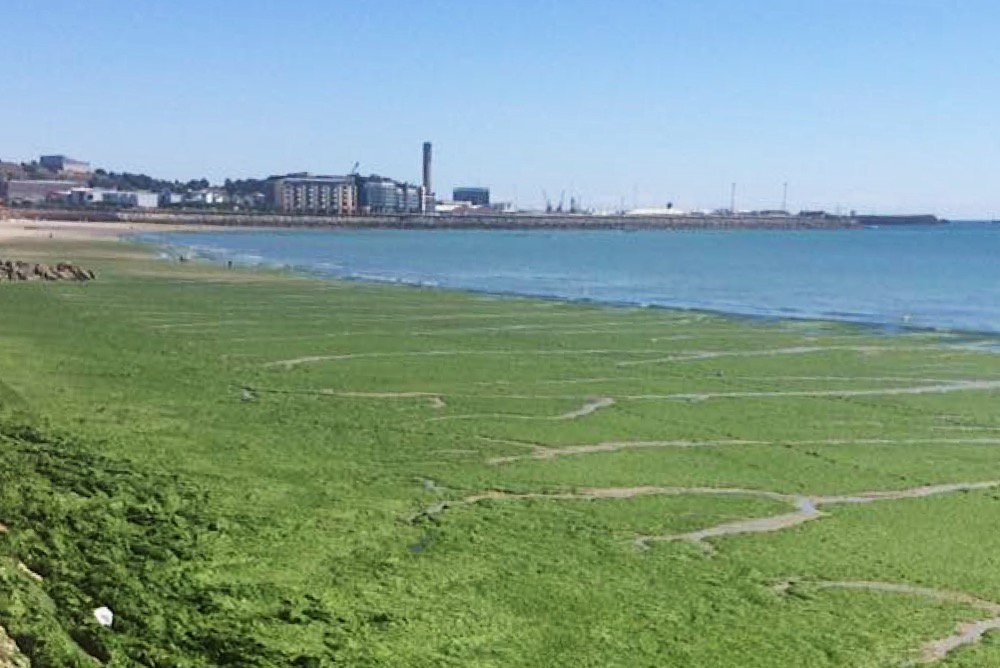
And did those feet in recent time,
Walk upon Jersey’s shoreline green?
And was sea lettuce on which we plod
On Jersey’s unpleasant beaches seen?
And did that countenance mixed with brine,
Shine forth there in shoreline strands?
And was a great heap gathered here
Among these green unwholesome sands?
Bring me my tractor, now so bold
Bring me my clearance I desire!
Bring me my rakes, O weed unfold!
Bring me my metal spokes of wire!
I will not cease from mental fight;
Nor shall my rake sleep in my hand
Til we have cleared this awful mess
From Jersey’s green unpleasant sand.

Friday, 14 August 2020

Gas In Jersey - Part 1


Gas In Jersey

A Brief History Of The Jersey Gas Company compiled by Roger Long from research by Robin S Cox and Rene H Le Vaillant 

JERSEY GAS COMPANY LIMITED

Directors
Peter Gilroy Blampied (Chairman)
John Roland Christopher Riley
Gerald Francis Voisin
Eric Ivor Messenger (Managing)
John Harold Vint
Colin Charles Beverley Sutton
Anthony Paul Langlois

Engineer and Assistant Manager
M. J. O’Keefle.

Secretary and Accountant
R. G. Le Blancq

Address:91 Bath Street, St. Helier 
March 1981


JOSEPH MORRIS 
Manager. Jersey Gas Light Company. 1862-1911

JERSEY GAS COMPANY

President / Chairman

T. Edge 1831-1856
E. Néel Jnr 1856-1873
G. H. Horman 1873-1879
J. Gibaut 1879-1887
M. Gallichan 1887-1902
A. J. Aubin 1902-1930
C. B. Buttfield 1930-1935
J. A. Perrée 1935-1954
C. W. D. Aubin. CBE 1954-1963
Jurat L. V. Bailhache 1963-1979
Jurat P. G. Blampied 1979-

MANAGER/MANAGING DIRECTOR
T. S. Peckston 1831-1843
C. Perchard 1843-1860
E. Néel Jnr 1860-1862
J. Morris 1862-1911
H. Morris 1911-1939
S. P. Pepin. OBE 1939 — 1961
W. Wedgwood 1961-1971
E. I. Messenger 191 —

Arial View of the works. 1954 


Sunday, 9 August 2020

Suppression of the Monasteries: Germany and the Holy Roman Empire


Suppression of the Alien Priories and Dissolution of the Monasteries

Jersey never saw the dissolution of the monasteries which happened later in England. That is because King John, having lost Normandy, decided that the priories in Jersey whose mother houses were in France, should be suppressed – they were considered “alien priories”.

Now we all know about the dissolution of the monasteries under Henry VIII and Thomas Cromwell, and that is invariable seen either as a good thing – they were corrupt and venal and had lost sight of their founding purpose – or as a bad thing – it was an anti-Catholic act!

The speed of it and the fact that it is part of English history – taught in schools, presented in history programmes – mean that it has become famous – or infamous.

But I began to thinking about Europe, for there were once thousands of monastic orders across Europe, not just in those territories which became Protestant, but also the Catholic heartlands. And yet there are not many around today. So what happened to them?

Protestant Germany

As might have been expected in Europe, closures also began in Germany. The significance here is the Treaty of Westphalia (1648) which ended the Thirty Years' War (1618–1648) in the Holy Roman Empire, with the Habsburgs (rulers of Austria and Spain) and their Catholic allies on one side, battling the Protestant powers (Sweden, Denmark, and certain Holy Roman principalities) allied with France, which was Catholic but strongly anti-Habsburg under king Louis XIV.

Soon after this, with Protestant Germany, more than a hundred monasteries and innumerable other religious foundations disappeared.

Josephinism: The Move to a Secular State

But parts of the German Empire remained attached to the Catholic faith. The major change came with the Emperor Joseph II.

“Josephinism” was a termed used for the collective domestic policies of Joseph II, Holy Roman Emperor (1765–1790). During the ten years in which Joseph was the sole ruler of the Habsburg Monarchy (1780–1790), he attempted to legislate a series of drastic reforms to remodel Austria in the form of what liberals saw as an ideal "Enlightened" state.

Regarding the Catholic Church, Joseph was virulently opposed to what he called "contemplative" religious institutions, which he saw as reclusive institutions that were seen as doing nothing positive for the community.

By Joseph's decree, Austrian bishops could not communicate directly with the Curia anymore. More than 500 of 1,188 monasteries in Austro-Slav lands (and a hundred more in Hungary) were dissolved, and 60 million florins taken by the state. This wealth was used to create 1,700 new parishes and welfare institutions.

The monasteries of Styria were soon closed, though some houses escaped at this time (Kremsmünster, Lambach, Admont). All those in Carinthia and the Tyrol were suppressed. The emperor showed no consideration toward the venerable Abbey of St. Martin of Pannonia and its dependencies. In Hungary the Benedictines were entirely wiped out.

The death of Joseph II put an end to this policy, without, however, stopping the spread of those opinions which had incited it. His brother, Leopold II (d. 1792) allowed things to remain as he found them, but Francis II (Francis I of Austria, son of Leopold II) undertook to repair some of the ruin, permitting religious to pronounce solemn vows at the age of twenty-one.

Bavaria

At the same time, The Elector Maximilian (Joseph) III (1745-77) began in Bavaria a work of suppression of monastic orders which was carried on by his successors down to the Elector Maximilian Joseph IV, Napoleon's ally, who became King Maximilian I of Bavaria in 1805 (d. 1825).

During the secularization of 1802–1803, monastic lands and buildings were seized by the state or sold. Bavaria became a secular state and many monasteries, although still referred to as such, nowadays house schools, businesses or even luxurious holiday accommodation.

The religious orders in Bavaria were first deprived of all property rights and prohibited to receive novices. The convents of the mendicant orders (Franciscans, Dominicans, Augustinians, and Carmelites) and the religious houses of women were the first to fall. Then came the turn of the Canons Regular and the Benedictines. The cathedral monasteries were not spared. Among the abbeys that disappeared in 1803 may be mentioned the following: St. Blasien of the Black Forest, St. Emmeran of Ratisbon, Andechs, St. Ulrich of Augsburg, Michelsberg, Benedictbeurn, Ertal, Kempten, Metten, Oberaltaich, Ottobeurn, Scheyern, Tegernsee, Wessobrünn.

North Germany

The monasteries in other parts of North Germany met with the common fate of all church property. On the left bank of the Rhine they were suppressed when that territory was annexed to France by the Peace of Luneville, 9 February, 1801.

The Diet of Ratisbon (3 March, 1801- February, 1803) reconstructed German States under the influence of France and Russia and as a consequence most of the ecclesiastical estates were abolished.

Besides her twenty-five ecclesiastical principalities and her eighteen universities, Catholic Germany lost all her abbeys and her religious houses for men: their property was given to Bavaria, Prussia, and Austria. As to the religious houses for women, the princes were to consult with bishops before proceeding to expel their inmates. The future reception of novices was forbidden. In the Netherlands, the Principality of Liège, and the portions of Switzerland annexed by France, the religious houses disappeared completely.

Concluding remarks

It is clear that a major force in the suppression of the monasteries was the Emperor Joseph II, who was concerned to modernise the Empire according to the ideals of the Enlightenment; he was always positive that the rule of reason would produce the best possible results in the shortest time.

As with England, a major barrier to some reforms was the power of the Catholic church, and while not breaking from Rome, Joseph was determined to limit its influence, hence the suppression of the monasteries, which by this time, as in England, had strayed far from their founder’s ideals and were wealthy institutions, effectively rich landlords who contributed little to society. Monasteries owned nearly half of all Church land, and something like 20 per cent of all land.

In 1750, for example, Maria Theresa (the mother of Joseph II) commented that “no monastic House observes the limitations of its statutes, and many idlers are admitted; all this will call for a great remedy”.

But unlike Henry VIII, Joseph’s suppression of monasteries was based on an ideal, that of “utility. Contemplative orders and nunneries therefore fell easily to his axe. Only those monasteries were to survive that worked in caring for the sick, in education or providing pastoral services in parishes. 

What mattered to Joseph was whether those religious houses brought benefits (hence “utility”) to the state. While Joseph dissolved monasteries that did not fit his criteria, he also transferred their resources to parishes and schools. 

In a move to more control over the church, clergymen were also deprived of the tithe and ordered to study in seminaries under government supervision, while bishops had to take a formal oath of loyalty to the crown. 

At the same time, his enlightened despotism included also the Patent of Toleration, enacted in 1781, and the Edict of Tolerance in 1782. The Patent granted religious freedom to the Lutherans, Calvinists, and Serbian Orthodox and the Edict extended religious freedom to the Jewish population.

By the time of his death in 1790, Joseph had cut off the Austrian Church from Rome, dissolved one-third of the monasteries in the Habsburg Empire, made marriage a state matter, granted toleration to Protestants, controlled clerical education, and restricted many religious activities.

And yet he was also part of a general trend against monastic orders and towards a more secular society across Europe. The religious wars that had been fought since the reformation has shown the bankruptcy of theocratic absolutism, and the gradual rise of tolerance and consequent reduction and movement against Papal control and influence.

Saturday, 8 August 2020

The Desert


This was prompted by the current heatwave reaching 35.3C in Jersey, and also thinking about hot places, hence the desert. But the desert is not just a place, it is also a metaphor for a land of lockdown, and isolation. Hence the reference to the "Desert Fathers", those who lived a life of solitude in the desert, and the oasis, because wherever there is a desert, there have also been places of calm for the weary traveller. I thought in particular of that pictured above, the oasis in Southern Tunisia, which I had the good fortune to visit in my late teens. It has springs, and springs in a desert are surely a sign of hope.

My father was driving our rented car, and asked the way of a man walking by the side of the road - he offered to show us the way, and the oasis, if we would drop him home. Home was a multi-generational collection of wooden bungalows, all scrupulously clean and tidy, and where the women dressed my mother in traditional Tunisian clothes. It was wonderful hospitality, and that has always been associated in my mind with that oasis. An oasis is not just a place, it can also be hospitality to the lost traveller.

The Desert

In the desert, air is liquid heat
Searing the lungs, breath is hard
Sand is burning beneath feet
The body wounded, scarred

Enclaves with the desert sand
Monks eke out a meagre life
The spirit with a praying hand
Away from world torn by strife

An oasis means water and shade
Palm trees beckon, rest a while
For this weary traveller prayed
A break from the time of trial

The desert here of faith and doubt
Hope springs in time of drought

Friday, 7 August 2020

Victoria Tower


This article dates from the late 1970s when there was an observatory dome on top of the tower, just visible in the above picture. I have also an extract on this from my book "Victoria College: A Chronicle 1972-1979" (available on Amazon in paperback or kindle edition) for the year 1975:

April saw the official opening of the Victoria Tower observatory. This was a facility available to all schools in Jersey through the Victoria Tower Astronomical Society, which itself, as the name implies, had close links with the College.

Victoria Tower

Here is an example of a true Martello Tower, such as are seen on the south coast of England, where about 150 of them were built. Eight were constructed in Jersey. All after 1800, and this one bears a stone over the main door with VR 1837. It has a narrow dry moat and is in a very commanding position above St Catherine's Bay. It is built in granite, and unlike some of the other examples, is not plastered.

Seen in the background is the breakwater, the result of anxiety over the activities of the French on the opposite coast. It was started in 1847; in 1852, when only one arm of the proposed deep water harbour was complete, work ceased. The advent of steam made it unnecessary, as shipping was no longer dependent on wind, but doubtless political events. and a rapprochement with France under Napoleon III, as well as the colossal cost of the project, also influenced the decision. The great breakwater in Alderney had the same history, but in our case the one arm was completed and so does not constitute a danger to shipping as does the unfinished arm in Alderney.

The white dome on the top of the tower is a housing over the telescope used by the Victoria College Astronomical Group, the tower offering an excellent observatory, and their activities being an equally good use for a tower which no longer has a defensive role to play.


Tuesday, 4 August 2020

A confusion of nationality, race and geography


According to the JEP:  

A SENIOR civil servant has been accused of playing the ‘race card’ during a Twitter spat with Jersey’s Australian community representative.

 The phrase in question was “such antipathy for an antipodean!’”

 An Antipodean, according to the dictionary, is a person from Australia or New Zealand.

 As far as I am aware, the fact of being an Australian or a New Zealander, is a reflection of national identity rather than racial identity.

 While the term “Asian” might be thought to be more certain, in terms of ethnicity this itself is a category with loose boundaries. As Wikipedia notes:

In parts of anglophone Africa, especially East Africa and in parts of the Caribbean, the term "Asian" is more commonly associated with people of South Asian origin, particularly Indians, Pakistanis, Bangladeshis and Sri Lankans.  In South Africa the term Asian is used in the pan-continental sense. Due to the high number of Indians in South Africa, in official documentation the designation "Indian" is used to refer to both South- and East-Asians.

An academic study of who was considered Asian in America showed the same kind of  loose boundaries:

For White, Black, Latino, and most Asian Americans, the default for Asian is East Asian. While South Asians – such as Indians and Pakistanis – classify themselves as Asian, other Americans are significantly less likely to do so, reflecting patterns of “South Asian exclusion” and “racial assignment incongruity”. College-educated, younger Americans, however, are more inclusive in who counts as Asian, indicating that despite the cultural lag, the social norms of racial assignment are mutable.

But Australians, colloquially referred to as "Aussies", are people associated with the country of Australia, usually holding Australian citizenship. Their racial origins may vary enormously. And that’s not even considering Australia's indigenous peoples, comprising Aboriginal Australians, Aboriginal Tasmanians and Torres Strait Islanders!

Now it is true that just as Australians refer to the people of England disparagingly as “Pommes”, and as one individual pointed out online:

It's not derogatory but there is in general a polite reluctance to use plural adjectives as nouns like Asiatics, the Japanese... and a preference for Asian people, Japanese people, etc. Perhaps Antipodeans falls in the same category?

But it also occurs quite naturally and not as any form of insult:

An Australian writer says: “"I published my first book in 1955, when I was living in London, at that time the great cultural metropolis for Antipodeans"

‘Antipodean wines’

‘Go into any bar in the county and before long the chances are you'll come across a member of the bar staff with that distinctive Antipodean twang.’

‘Apologies to any Antipodean readers; just throw another Turkey leg on the Barbie for me and I will be right over.’

But whatever the case, one thing is clear – it is not racist, unless we start defining membership of a race as equivalent to membership of a nation, which is clearly not the case.

 Those who have called out the politician for “playing the race card” are quite simply wrong. There is a an alarming tendency to play the racist card when it does not apply.


Saturday, 1 August 2020

Escape into Light


Escape into Light

The city, alone, a land of shadows
Empty streets, strange masked folk
Time at this level crawls and slows
Such a heavy burden in this yoke

Saturn in the night, gleaming rings
Jupiter the mighty, still and bright
The harmony of the planets sings
And the moon rising, pale, white

At the beach, buckets and spades
Holiday in the sun, freedom’s cry
Time to leave behind the shades
Into sunlight, sand, sea and sky

Sometimes hope is all we need
Just as when we plant a seed