Showing posts with label Rob Duhamel. Show all posts

Friday, 11 April 2014

Paradise Towers

"Build high for happiness" was the catchphrase used by the residents of Paradise Towers, in the Doctor Who story of that name. It would have been appropriate for Deputy Rob Duhamel who was sharing with the Chamber of Commerce his vision for St Helier's urban future.

The title seemed promising enough, and if it had been the Constable, Simon Crowcroft, giving the talk, I would imagine we would have had some very positive and realistic ideas put forward for the Town. Instead, we had a panorama of different buildings, some very modern styles, some very unusual ones, and alongside this, by way of soundtrack, Deputy Duhamel taking the audience on what can only be described as a journey Over the Rainbow to the Land of Oz, in which the boundaries of St Helier should be delineated by planting nut trees.

Building high was one of the Deputy's few realistic proposals, as he said this would avoid urban sprawl outwards. But then we had the idea that flats should become more centres of community, and more personalised. They might have green bushes growing up their walls. New flats might have a communal swimming pool. Quite who would pay for all this and maintain it never seemed to cross the Deputy's mind.

I know some flats have been too small, and there are good grounds for stipulating minimum sizes for internal spaces, but while the Constable was talking about this on BBC Radio this morning, that aspect did not appear as much a priority in the Deputy's remarks as he took us on his tour.

Although my concentration was drifting at that point, I'm pretty sure about the communal swimming pool. I know that the flats in Paradise Towers had such a facility, and it seemed strange that the good Deputy should be thinking along the same lines. There should also be spaces within buildings, and to the side of buildings, and balconies, and bright, bold, colour schemes. And urban farms, or something urban where green things grow. And the buildings would be tall, to avoid urban sprawl. Although not 30 stories, which is what he said was really tall. 10-15 stories, I assume, would be fine in the Deputy's vision.

Presumably we would be able to avoid the tall ugly buildings that stand out along St Clement - Les Marais Flats. The Deputy's vision, to go by the pictures, would have large rounded corners, curved surfaces, lots of sparkly glass surfaces, or if square would have multicoloured walls, and not look anything like Les Marais.

But would St Helier really take avante garde designs, and would they be liveable in? Would transporting a pastiche of Valencia modern architecture to Jersey work? One can, by the way, see why the Deputy is enamoured of Dandara's reflective glass design for offices.

Of course, most of us live in the real world, and there, buildings get run down, with broken lifts, and need maintenance and cleaning. Urban farms on rooftops would require even more. And spaces beside buildings are ideal places for trapping litter. Bold colour schemes need repainting, and would they really be that nice?

I know people say that the vivid custard yellow of Normans has grown on people, but I can number at least several dozen people who still think it is something to tolerate. That is not so important for a brand image. Go-compare gained notoriety by having an advertisement that everyone hated. And the same is true of buildings selling a brand. But would you want to live in something that colour?

Meanwhile, Deputy Duhamel was telling us that people now identified where they lived by postcode, and needed to regain a sense of place. I don't know what strange people he has been talking to, but while I may identify my address by postcode when online entering forms, if I want to give someone directions for where I live, I would say 24 Moonshine Apartments, Gloucester Street, and not 24 Moonshine Apartments, JE2 4QX.

People don't as a rule think of where they live by postcode, but Deputy Duhamel seemed to think they did. Perhaps he'd been reading too much science fiction. This talk about "personalising an address" did not chime with how people in the real world behave, although I could imagine such a scenario in Isaac Asimov's "Caves of Steel". Is the Deputy confusing fiction with reality, I wondered, as I know he is an aficionado of Asimov's works?

He went on about the fact that we needed to rethink places like the Central Market as they declined. Clearly, he doesn't visit the Central Market much. It is bristling with stalls, and to use his favourite adjective, is vibrant. Fruit, vegetable, flower stalls, places for snacks and refreshment, the Red Triangle stores, chocolate shop etc. It still has charm and character. The main threat to the Central Market is the idiotic scheme to knock down the short term shopper's car park at Minden Place, which I believe is still somewhere in the future planning stage.

Now St Peter Port'sMmarket did need to be rethought and revitalised. It was quite different. I remember going to Guernsey, and it became steadily more run down, more empty, until it closed. It had a great disadvantage; it did not have a central fountain, and a great canopy of a roof, and was more long aisles with stalls one side or sometimes both. It lacked the character that St Helier's market has.

St Peter Port has urban sprawl, but it also has a very attractive town centre, with cobbled lanes, and a harbour that is delightful to look out on. While the Deputy (and Simon Crowcroft this morning) criticised the urban sprawl all the way to St Samsons, they didn't say much about the charm which the centre of St Peter Port has, and which is rather missing from St Helier.

And along went the Deputy, churning out clichés and truisms as if he had pillaged an entire dictionary. One man's meat is another man's poison. We are all different. None of us are the same. We are all individuals. And as the Old Harbour is no longer a trade port, how about removing the boats which have lost their raison d'etre for being there (as they are not commercial), filling in the Old Harbour and replacing it with flats. I suppose you can't expect a talk by Rob Duhamel not to have trademark lunacy somewhere there.

This was a build up to the grand finale, in which he showed us a photo montage from above of what "La Collette Village" would look like with St Malo superimposed on it. There's all that reclaimed land, it's just warehouses, it is ugly, and it could be a whole community of buildings for people to live in. The incinerator could be build elsewhere when it needs replacing. The fuel farm could be moved elsewhere. We were not told where. That's the kind of messy detail that spoils a fantasy.

By this time, the talk had rambled probably far over an hour, and most people, as I looked around, seemed to have lost concentration, fallen asleep, or were using their smart phones. Deputy Sean Power obviously thought it was a good time to catch up on the news about RBC and the waterfront, and tweet on it. Events were overtaking Deputy Duhamel's visions, and even Senator Philip Ozouf's vision of an International Finance Centre.

The Deputy eventually came to the end of his talk, and there was a moment for questions. There wasn't a question, but one person did speak up to say they didn't agree with the Deputy's vision, and that some of us had work to do rather than spending something more like two lunch hours at the event. No questions, because people were desperate to get away, and back to their offices!

The event was packed, but I suspect if the Deputy speaks again, it will be the long haul for those with stamina, and the numbers will be considerably less. The Chamber clearly needs to set firm guidelines in place for a talk, or people will simply stay away.

There are going to be workshops, and other seminars to look at a "Future of St Helier" strategy, with a hash tag #futuresthelier. Unless they are radically different from the contents of this talk, I can't see much in the way of attendance. Talking shops are all very well, but as Simon Crowcroft said this morning, there are a lot of good ideas already in the pipeline which need addressing.

The problem with the Deputy's ideas is that they present very large pictures, but have no fine details at all. It's like looking at mountains, and thinking it would be nice to climb them, but without looking at training and gear. It lacks feasibility.

What would I like to see on the table for the future of St Helier? These are rapidly sketched ideas, and may not be much good. But they are all feasible. They look at what is there, and how we can work with it, and develop it.

Parking - getting short term commuters in and out, and also parking for office workers who, after all, often use St Helier's refreshment facilities during lunch times. Minden Place should not go until there is a replacement catering for the same number of cars. Congestion was also mentioned by the Constable this morning; it was scarcely touched upon with any realistic suggestions by the Deputy.

Blended design - where there are modern buildings of glass and steel, more will blend in. But where there are older historic buildings, modern ones unless designed to fit, stand out like a sore thumb.

Older buildings - these are often now multiple flats, and some are kept well, flower beds, while others are positively tatty. Something needs to be done to address this.

Civic pride - any festivals, bands marching down King Street (I remember that was daily in the Summer) is not only good for tourists, but instils a sense in which St Helier is a place to be proud of.

Rentals and leases - a look into high rentals and terms of leases in St Helier. Despite assurances, there still seem to be a large number of empty shop fronts.

Revitalised harbour - buses, café - where did they go? It is a scandal that the Ministers responsible  - EDD and TTS - haven't done much about this at all beyond shrugging shoulders.

Keep fit walks - leaflets giving historical and / or spotters guides - good for tourists, good for locals to keep fit and go different ways through town in lunch hours. Younger children would appreciate an "Eye Spy" leaflet, especially if it ended at one of the parks.

I'm sure other people can come up with better ideas, and if I get enough, I'll do another blog!

Wednesday, 9 April 2014

Fantasy Island comes to Jersey

Do you remember the TV show called "Fantasy Island"? It starred Ricardo Montalbán as Mr. Roarke, the mysterious overseer of a mysterious island somewhere in the Pacific Ocean, where people from all walks of life could come and live out their fantasies, albeit for a price.

I sometimes feel that there are a few Jersey politicians who are behaving as if they were on Fantasy Island, living out their fantasies, whether it is a Minister permitting  grants of £200,000 to film companies apparently with very little due diligence before signing off the cash, or a Minister sounding out across the Island on BBC Radio Jersey about how police should be armed with a Spiderman web gun.

Here, then, are two examples of local politicians who have strayed onto Fantasy Island. The price, in this instance, is met by the taxpayer.

Crystal Ball Gazing

I see from the JEP that the film Crystal Island has been delayed and may not start in the summer at all:

"Keith Cavele has met Economic Development representatives to discuss the latest developments in the Crystal Island project. Plans for developing a network of creative industries to support film production generally in Jersey were also discussed. While the meeting has been described as 'productive' by both parties, a number of setbacks with the film have also been identified which could lead to the filming schedule being delayed further." (1)

A cynic might translate that line about "setbacks" as follows:

Director: We need more cash
EDD: Well, we can't give you any!

Isn't it interesting that when matters are good PR, as when the film was first mooted, the Minister - Alan Maclean - was the person grabbing the headlines and publicity, but when the news is not so good, it is just "representatives" (and who are these nameless individuals?) meeting Keith Cavele.

I think Senator Maclean deserves an Ostrich of the Week Award. The golden Ostrich is like the Oscar, but it is handed out to people who give away taxpayers money to film projects which may never be made. And then bury their heads in the sand.

I wonder if the Senator will be in the audience to see Psychic Sally at Fort Regent, or request a private consultation to look into her crystal ball and see what the prospects of Crystal Island are, or for that matter, his chances of re-election.

The Amazing Duhamelman

Every so often Rob Duhamel astounds me with the extraordinary off the wall things he says. I have to pinch myself to make sure I am not dreaming, and that an elected politician could actually say such things seemingly without embarrassment.

This was the case on Sunday, when in the Politics Hour, the subject of Tasers came up. Subject to the most stringent rules on deployment, including permitting only trained firearms officers being allowed to use them, the States have voted in favour of their introduction.

That last requirement, which I made the case for in my own submission to Scrutiny, is necessary. A trained firearms officer not only knows how to fire accurately, he or she also is trained not to be trigger happy. Training is as much about learning not to deploy the firearm except as last resort as using it. That's unlike some UK forces, when a minimal training is given to ordinary officers, sometimes leading to tragic consequences.

But Deputy Duhamel was firmly against Tasers full stop. Citing Isaac Asimov, "Violence is the last refuge of the incompetent", he gave the impression that any use of force by the police must therefore reflect badly on their competence. I suspect he has rarely been confronted by aggressive drunks.

In fact, of course, it is not Asimov who says that, but a character - Salvor Hardin - in one of Asimov's Foundation stories. To identify a character's beliefs with those of the authors is a mistake; if it is not a form of the biographical fallacy, it comes close. In another of the stories, the heroine saves the day by shooting a psychologist with a blaster before the villain learns their secrets. There is not one iota of criticism in any story on this; rather the narrative, and other characters praise the courage of the heroine.

Having said his piece, Deputy Duhamel suggested the police response should perhaps also look to science fiction, and to the hero known as the amazing Spiderman. He shoots webs from his hands and these wrap round the villains, and incapacitate them in a harmless way.

Why, speculated the Deputy, could not the technology be developed for a "gloop gun" which would ensnare the violent criminal in sticky goo, and prevent them from hurting anyone?

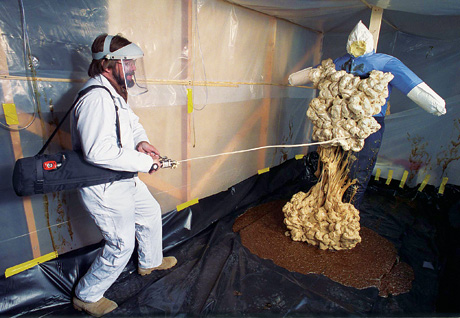
The obvious answer is that Spiderman is a fictional character, and his spider web does not exist in the real world. But apparently something rather like a "gloop gun" does exist - my thanks to Dave Rotherham for pointing it out. Wikipedia noted that:

"Sticky foam is an incapacitant, used when less lethal force is required, consisting of various extremely tacky and/or tenacious materials carried in compressed form with a propellant and used to block, entangle, and impair individuals. A National Institute of Justice-funded project at Sandia National Laboratory developed a "gun" which could fire multiple shots of sticky foam."

However, there is a fly in the ointment (an appropriate cliché where Spiderman is cited!):

"Problems with this technology include: the serious risk of smothering (suffocating) the subject; skin clean-up (the foam may not be toxic, but solvents are often harsh); "gun" clogging; targeting and firing; and gun cleaning."

A photo of deployment can be seen at the end of this blog.

In fact, it is not nearly as simple to deploy as Spiderman's web gun, which is perhaps not surprising because that is, after all, science fiction. Here's a description:

"The image of soldiers blasting away with soapy-looking foam instead of using riot batons was almost quaint. With the foam stored in silver cylinders mounted on backpacks, the sticky foam gun had a kind of campy James Bond jetpack look to it, like something from the future, if your present is, say, 1958."

"After a person has been immobilized, the sticky foam, which is made out of rubbers, resins, oils, and flame retardants, can be removed, eventually, with hard scrubbing and baby oil."(4)

The official tests have this to say:

a) sticky foam adheres immediately to skin,
b) mineral oil (baby oil) is a reasonable cleaner for removing sticky foam from skin,
c) Using mineral oil to remove sticky foam from skin requires significant mechanical effort (5)

Its deployment was not perfect; some physical force was also needed to subdue people after the sticky foam was used, and there was a potential suffocation risk

There seemed however to be no indication that Deputy Duhamel was aware of the problems with sticky foam when he was eulogising about his "gloop gun".

I sometimes get the feeling that the good Deputy has some good ideas, but he never quite manages to subject them to critical thinking before unleashing them on the general public.


No, the bearded holder of the gloop gun is NOT Deputy Duhamel!

Links
(1)   http://jerseyeveningpost.com/news/2014/04/08/fantasy-film-may-not-start-this-summer/
(2)   https://www.jersey.com/English/sightsandactivities/eventscalendar/Pages/Event.aspx?AttractionID=7987
(3)   http://en.wikipedia.org/wiki/Sticky_foam
(4)   http://cabinetmagazine.org/issues/22/mcweeny.php
(5)   http://www.aquafoam.com/papers/Scott1.pdf
(6) http://cabinetmagazine.org/issues/22/STICKY-FOAM-1_v2.jpg

Monday, 7 April 2014

Energy Visions of the Future

"Minister's vision: Buy your own wind turbines. Islanders should adopt a Scandinavian approach to power by forming small energy communities and buying wind turbines and patches of roof-top solar panels, the Environment Minister says."
 
"The ambitious plans, Deputy Duhamel said, could see 1,000 households or more joining together to buy a wind turbine to power their homes, freeing them from the energy costs of a single mainstream supplier."(1)
 
The Jersey Evening Post reported on this story earlier this week, and I took a look at a couple of publications on the topic.
 
Ian Woofenden has written a book on "Wind Power for Dummies", and while it in theory allows someone to set up their own wind turbine, it also gives a good idea of the scale of the problem. Apart from the wind generator, the tower, wire and associated equipment for transmission and batteries for temporary storage, there are also a grid interface, metering, disconnects, overcurrent protection, grounding a more to ensure the system is safe. As he noted "There's a lot of detail to understand here, and unless you already have experience under your belt, you need support in this realm."
 
And he says "Wind energy is not a build-it-and-walk-away proposition. These systems require regular maintenance. At least once a year - and maybe twice - someone needs to lower or climb the tower to check the wind generator, do all scheduled maintenance, and address any problems. On the ground, batteries are the primary focus for maintenance, but you need to be aware of other system components and their calibration, too."
 
He explains clearly why this is the case. "Turbines live in a very harsh environment, high above the ground, where they're punished by very strong and variable winds. Turbines are rotating machines that spin, sometimes at very high speeds. Where you have mechanical motion, you'll have wear and tear". Higher than average wind speeds will increase the wear and tear, and exceptionally high wind speeds can potentially damage the turbine, as was seen on television a few years ago, when the turbine caught fire.
 
I have also been perusing a copy of "Home Power" magazine, which also looks at maintenance - "never buy a turbine solely on its up-front cost, but rather on what it will cost you over the long haul - money, time and aggravation. Wind electric systems are the toughest renewable energy systems to maintain, with the highest failure rate. Why? Because wind turbines live in a brutal environment atop 80 to 120 foot towers not readily accessible if you don't climb."
 
While small energy communities may be found in Scandinavia, where there are relatively remote clusters of dwellings for which wind power may be more suitable, Mr Woofenden comments that this is not true of all locations - "There are places where wind-electric systems just do not make that much sense - densely populated urban and suburban areas are not a great choice" Taking a map of Jersey, I would imagine that the more urban parishes would largely be ruled out.
 
And in more general matters, my correspondent Adam Gardiner had this to say:
 
"Facts and costings seem to be in short supply with the Minister's suggestion. For a start, the costs are significant --we are talking hundreds of thousands of pounds to set up a system to generate a 240volt supply. But also it should be noted that these will require qualified specialist electrical engineers and to install and maintain them."
 
"And there are other problems. What about your problems if you wish to move out from your "energy community". This raises all kinds of legal issues which have not been considered. As well as this, a prospective buyer of a property could be told they are locked into some sort of energy deal which the property is rigged up to. This could lead to all kinds of problems with property sales, especially if there are rising maintenance costs after the turbines have been in place for some years."
 
"Then there are the obvious and endless complaints. There could well be grounds for nuisance, both because of the noise, and also the visual aspect. Planning consent would be needed which at the present time precludes such a construction by virtue of the Island Plan."
 
"Who would oversee such work as to assure that a 240volt supply complied with the standards required? A vision of the future energy needs? I rather think the good Deputy should go to Specsavers!"
 
"Affordable and viable energy for Jersey is an island issue and best left in the hands of those who provide our energy needs at present as that have the expertise - and the network. That is not to say that the JEC should not be pursuing a policy of exploring our natural resources that could make Jersey more self-sufficient in the future. I should be surprised if they are not. That the States are encouraging this seems to be in some doubt. The impetus provided by the late Constable Dan Murphy seems to have ceased."
 
"But what seems to be the worst case scenario would be wind-turbines springing up ad-hoc all over the island at the expense of both the visual landscape and the ability for the JEC to invest in future technology to the benefit of the common good of us all"
 
"For my money, given we are surrounded by water and experience some of the highest tidal ranges in the world, energy from the sea seems to be the most practical and sustainable solution. I am sure it's not the cheapest option but is clearly the most reliable."
 
One thing that does come from reading Ian Woofenden's book is that Deputy Duhamel's second suggestion on solar panels may be the more viable one. It is a shame that the Jersey Evening Post's focus, concentrates on the wind power, which seems a very costly option. I noticed that in the politics hour on BBC Radio Jersey, or at least the portion I heard while driving, the Deputy was concentrating on solar panels, which was much more feasible.
 
Mr Woofenden notes that:
 
"In my 25 years of using wind and solar electricity, my PV modules have just sat on the roof doing their job. I wash them a few times a year, but other than that, I've had no involvement. In the same time period, I've had multiple wind generator failures, and my machines have all needed regular maintenance."
 
"Another bonus: Besides being simpler and more reliable, solar-electric systems are more modular than wind-electric systems. Expanding as your interest or budget allows is relatively easy (though some planning ahead is advisable if you think growth will be in your future)."
 
And he also notes that solar panels have a much wider scope in terms of placement:
 
"Many, many more people have a good solar site than have a good wind site. PVs can go on roofs, poles, and ground mounts in the city, suburbs, or wherever. Good solar sites have clear access to full sun all day, or at least for the peak hours of 9 a.m. to 3 p.m. Though not all sites have good exposure, I'd say that for every good wind site I look at, I probably look at 40 or 50 good solar sites."
 
The National Renewable Energy Laboratory in the USA provides provide monthly average daily total solar resource information on grid cells for the country.
http://www.nrel.gov/gis/solar.html  
 
And the UK Met Office does the same (albeit on a smaller scale) for the UK
http://www.metoffice.gov.uk/renewables/solar  
 
If Deputy Duhamel's vision is to be a reality, at least for solar energy, then a helpful precursor would surely be to determine which areas in Jersey would be viable.
 
There is at least one company into solar energy in the Channel Islands, the Little Green Energy Company, and their testimonials are promising.
http://littlegreenenergy.gg
http://www.littlegreenenergy.gg/Customer_Testimonials.htm
 
While solar energy is not likely to completely replace grid power, it seems to be a more viable option than wind power. It is less noisy. It may cost, but it requires far less maintenance. Perhaps there is room for at least part of Deputy Rob Duhamel's vision, after all.
 
But it would also be good to know who is now taking on the mantle of the late Constable Dan Murphy in the States in progressing work on the viability of wave power. There is no need to have all the renewable energy eggs in one basket.
 
References
(1)   http://jerseyeveningpost.com/news/2014/03/31/ministers-vision-buy-your-own-wind-turbines  
(2)   Wind Power for Dummies, 2009, Ian Woofenden
(3)   Home Power Magazine, Jan 08, Issue 122

Tuesday, 21 January 2014

A study of conflict resolution in the case of Ian Gorst and Rob Duhamel

 "Chief Minister, Senator Ian Gorst, wanted the States to sack Deputy Rob Duhamel after claiming he could not work with him any more. He said he withdrew his proposition after "constructive dialogue" with Mr Duhamel meant they could find a way to work together. He said he "regretted" the way matters had escalated. Mr Gorst said earlier this month Mr Duhamel did not work well with other ministers who had "lost trust and confidence in him". But in a joint statement, the two men said they would work together to improve communication. " (1)

The resolution lacks the spectacle of a political punch-up, and let's be honest, it is pretty clear that there was a certain voyeuristic element in the impending vote of no confidence. How could it be otherwise, with a public weaned on the "Celebrity" game shows which thrive on sadism? Some of the comments I have seen suggest that the public feels cheated of the fight.

And so there has been a lot of talk lately with lurid headlines on Facebook and elsewhere of the kind that says "Gorst collapses", and the general feeling is that he decided that he could not win a vote of no confidence against the Planning Minister.

But I don't think that's the whole picture. Certainly there has been a groundswell of support for Deputy Duhamel, some of it, I understand, from within the Council of Ministers. And there has also been the feeling, expressed by Matthew Price on BBC Radio Jersey in an interview with Ian Gorst, that Senator Ozouf was given another chance, and made commitments to improved working practice, and why should the same consideration not been shown to Deputy Duhamel. I wouldn't be surprised if Deputy Gorst has taken those matters on board in reassessing the proposition.

Yet the most important part of the news has been overlooked. Senator Gorst met Deputy Duhamel. They talked together; they managed to take the heat out of the conflict, and actually issued a statement which was a constructive way forward.

The last time a Minister was "sacked" by a vote of no confidence was Senator Stuart Syvret, ousted by Senator Frank Walker. The two were at loggerheads. They would have needed some kind of referee to talk together, as it was clear there was a lot of animosity between the two. So far from politics being about issues, the distinct impression was that a lot of that conflict was a clash of personalities. It was unlikely that any common ground could be reached.

That happens a lot with political disputes. A lot of the phraseology betrays the kind of thinking behind the conflicts. One comment on Twitter asked whether Ian Gorst was "man enough to resign" if he lost the vote. This is the world of boys games, of schoolboy fights, and while these comments are being made by grown adults, they have not really left the playground that far behind.  

People prefer not to talk and sort out differences, especially men, where it is seen as a sign of weakness. "Man enough" itself is redolent of a particular kind of masculine posturing, where any compromise is seen as a sign of weakness. We don't say "woman enough". In fact, the far harder task is to step back, and talk, and defuse conflict.

It is not really a sign of weakness to negotiate for peace rather than lobby hand grenades over into the other trench. Do we really need this kind of "strong man" approach to politics in Jersey? Do we really need all the old ingrained patterns of defending, withdrawing, or attacking in the face of judgment and criticism? This is the way politics has been shaped, with blame, insults, put-downs, labels, criticisms, and comparisons - all forms of judgment which block out the ability to listen.

The "strong man" approach issues demands that implicitly or explicitly threaten the other with blame or punishment if they fail to comply. These are the patterns of control and power. Isn't it much better to really listen and negotiate instead?

Marshall Rosenberg, founder of "Non Violent Communication", commented on the psychological aspects of the desire for control that is so often toxic:

"In this type of system, only some people have the power of having their needs met, often at the expense of other people's needs not being met. Thus, this destructive mythology fuels moralistic judgments and sets the base for a domination system -expressed in a language that brings pain in relationships and violence in the world." He argues that what is needed in situations of conflict is to establish connection with other human beings.

There is a crucial difference between non-violence and passivity; the former is an act of compassion, of taking the trouble to speak and listen, whereas the latter is one of submission. Had the proposition just been withdrawn, that would have been a purely passive action, but instead, a joint statement was issued, which set forth methods to resolve future conflicts and work together better.

And language is critical in how we defuse conflicts and seek a peaceful resolution. As Rosenberg notes:

"We are unconsciously and habitually influenced by language processes that affect our choice making by distorting our perceptions. The language we use and the thoughts we have inform the kind of actions we take."

Talk of "weakness" or "cowardice" is the kind of language that can destroy any conflict resolution. It is the language which Nietzsche used to denigrate Christianity.

A non-violent approach means turning away from a mentality which sees opposition as trench warfare, and instead seeks not to defeat or humiliate the opponent, but to win his friendship and understanding. This, Rosenberg says, means taking responsibility for our actions in increasing conflict or seeking peaceful solutions:

"Taking responsibility for ourselves diminishes the probability that we will use coercion to get our needs met or submit to others who choose it as a strategy"

If we look at part of the joint statement, we can see an admission of faults on both sides, an apology from Deputy Duhamel, an expression of regret from Ian Gorst that there was an escalation of events which led to this point, and a joint commitment to work together in a constructive manner. There is also a commitment to work towards dialogue and mutual understanding between all Ministers.

That's a statement of taking responsibility for mistakes on both sides, and moving matters forward. It's what used to be called "consensus politics", and there once was a good deal more of it in Jersey politics.

When the old committee system ended, power was concentrated in a very few individuals, and the system was almost designed for bullying, intimidation, and all those patterns of control learned in the playground.

It was not helped by two Chief Ministers who did very little to build political consensus, preferring to have the Council of Ministers consisting of a narrow range of political viewpoints. That's something that comes again from school - team games, where the captain picks their favourites. Senator Gorst made a strong effort to buck that trend and have a more diverse range within the Council of Ministers, and the conflict with Deputy Duhamel demonstrates, as their joint statement shows, that more is needed to be done for that to work.

In the meantime, at least two politicians who were at loggerheads have managed to meet and thrash out a way forward to resolve the conflicts between them. That is something commendable, and a promising start. Some people don't seem to like peacemakers, but that's the only way we are going to improve politics in Jersey.

"Peace is not merely a distant goal we seek, but a means by which we arrive at that goal" - Martin Luther King Jr

"Peace cannot be kept by force, it can only be achieved by understanding"
- Albert Einstein

"If you want peace, you don't talk to your friends. You talk to your enemies"
- Archbishop Tutu

"I dream of an Africa which is in peace with itself"
- Nelson Mandela

References
(1)   http://www.bbc.co.uk/news/world-europe-jersey-25751645
(2)  There are many books on Non-Violent Communication, but "Nonviolent Communciation: A Language of Life"(2003) by Marshall Rosenberg was the one recommended to me by Annie Parmeter, who introduced me to his ideas, as well as to the feminist critique of male power games.

Monday, 20 January 2014

Odds and Ends

Is it time to make Rob Duhamel a Grade Two Heritage Listing?

The 1937-built white arrivals building at Jersey Airport has been awarded a Grade Two heritage listing. But the listing is at odds with the airport authorities who have applied to demolish it. They have cited a requirement to comply with current safety standards. (1)

Rather like houses, this is another example where historic value is taking precedence over function. The whole airport has been restructured internally considerably, so I'm at a loss quite what is now being frozen in amber. But precisely what heritage function will this serve? Are there to be trips out to see the arrivals hall, pointing out its unique architecture? If it is important to retain a record of it, why not do that, by making a comprehensive photographic archive of the site?

I heard Christopher Scholfield talking this morning about its unique character, and that we should make more of it when tourists arrive, but if changes are not made, they will be stuck in fog more often because of safety, and I'm sure when they do make it to Jersey, after delays in UK airports, they will not be in much of a mood to ponder the marvels of 1937 architecture. And why did the BBC debate centre on safety in terms of "fireballs" anyway? The safety aspect means less flights possible on foggy days, which is bad for tourists and islanders alike. Safety means you don't fly; not that you fly anyway regardless!

It is a building from 1937, not something of a Victorian or Edwardian masterpiece; it was designed pretty well to be functional, as an arrivals hall. And clearly the planners who decided this would like to prioritise heritage over passenger safety. I can think of no other period in Jersey  history which has such a fixation with ossifying the past without any common sense applying.

Perhaps Jersey folk were too ready to knock down old buildings and structures in the past, as the incomplete dolmens across the Island bears witness. But churches were adapted, changed, built onto, because their function was for a congregating people to worship, and what we have today is a historical evolution. It is only today that we also realise the historical value, but if we applied today's standards to the original buildings, all we would have in each case would be 12 small squalid little chapels, probably damp, and certainly neglected in favour of larger buildings which served the function for which the original chapel was intended.

And I'm not impressed by the Heritage lobby's acting to try and prevent wheelchair access to church buildings. There was a refusal to allow wheelchair access to a Methodist church in St Martin, thankfully overturned. The founder of Christianity, if he was alive today, would have had some rather trenchant remarks to make about that refusal. I seem to remember he was not particularly impressed when his disciples marveled over the heritage aspects of the Temple in Jerusalem.

No Excuses Please

"Preparations for Jersey's Historic Abuse Inquiry are well underway, as the Committee gears up to start the public hearings in May. Committee members are interviewing lawyers in London this week in order to appoint an independent legal team to support the Inquiry."

Carrie Modral said: "Some of the information held on abuse victims such as psychiatric reports, police reports and obviously because of the data protection law they're saying they're going to have to heavily redact these documents and in fact I've been told it probably won't be worth giving half these documents across."

Data Protection Commissioner Emma Martins said they will not get in the way of the Commission.  Emma Martins said:"For the avoidance of doubt, the work of the Committee will not be fettered by the Data Protection Law - there will be nothing in the law stopping individuals from giving information to the Committee or organisations such as the police force from handing over records. "To be clear, no one will be able to claim that the Data Protection Law prohibits them from answering questions put by the Committee or to avoid handing over whatever the Committee wants to see." (2)

I was very hearted to read that quotation about Data Protection from Emma Martins as I had concerns like Carrie about Data Protection being used to block documents. The Inquiry should have access to all documents. Obviously how much of that may enter the public domain in their report might well depend on matters such as Data Protection, but they should have no restrictions whatsoever, either from Data Protection, or on some spurious legal grounds, for not having sight of all the relevant material.

Public inquiries can go several ways. They can help get at the truth, or they can become a convenient way to stifle a controversial issue. In the UK, the Hutton inquiry, which ended in emasculating the BBC, was very much seen as a whitewash, not least by Private Eye, which argued that the terms of reference and the way the inquiry followed them, could only lead to one outcome - namely, to exonerate the government and silence critics.

On the other hand, some inquiries have drawn attention to important issues which might otherwise have been neglected, such as the Scarman inquiry, which was independent and forthright in its evidenced critique of the police "stop and search", and the endemic culture of racism which existed with the force.

What Jersey needs is less Hutton, more Scarman, in how the inquiry gets to the truth, and a free reign to access all documents the inquiry deems relevant, and an independence that does not bow to any agenda.

The New Gravy Train

The new development at the Waterfront, in the original Hopkins Masterplan, was not going to cost a penny of taxpayers money, but now we have been told the development of "Block 1" will involve creation of a new underground car park to replace those lost to the office development.

The cost of that will, of course, be born by the taxpayer, as will the removal of any toxic ash or like materials from the site. The underground car park, we are told, will have the same number of spaces as before, which overlooks the question of where all the office workers are going to park.

Ever since it began, the Waterfront has leached money away from the taxpayer in one way or another, and this new development looks to be no exception. Once, the trains came along the coast not far from where the development will be, but now, for anyone getting those lucrative contracts, it will be a new gravy train, and who knows where it will end. Unlike the old railway service, the new gravy train can always be bailed out by the Treasury Minister from his seemingly bottomless contingency fund.

CCTV in Jersey

"A knife-wielding raider threatened staff at a Co-op in Jersey and demanded cash from the till. The man went into the Co-op in Val Plaisant, St Helier, at about 08:00 GMT but when told there was very little cash, "panicked" and fled, said the manager. Manager Lloyd Hotton said: "It could have been much nastier. I'm just glad no-one was hurt."(3)

The CCTV in this incident, as seen in a photo, reveals very little, showing that whatever recommendations the Scrutiny Panel comes out with, it is largely hypothetical unless better imaging is available. The clothing is patterned, but looks as if it is well-worn and may have been bought second hand; he also looks as if he is padded out to look more stocky than he actually is. Apart from the fact that we know that he is white, and what his height and shoe size are, there is very little else that can be discerned from the image.

http://www.channelonline.tv/channelonline/DisplayArticle.asp?ID=509176

And Finally... Placenames

I rather like the letter from Frank le Maistre in 1980 on place names, seen here. "Hands off our ancient and venerable place names", he concludes, after warning against removing the definite article.

http://officedujerriais.blogspot.com/2014/01/1980-jersey-place-names.html


References(1)   http://www.bbc.co.uk/news/world-europe-jersey-25792861
(2)   http://www.channelonline.tv/channelonline_jerseynews/DisplayArticle.asp?ID=509097
(3)   http://www.bbc.co.uk/news/world-europe-jersey-25800861