Wednesday, 9 April 2014

Fantasy Island comes to Jersey

Do you remember the TV show called "Fantasy Island"? It starred Ricardo Montalbán as Mr. Roarke, the mysterious overseer of a mysterious island somewhere in the Pacific Ocean, where people from all walks of life could come and live out their fantasies, albeit for a price.

I sometimes feel that there are a few Jersey politicians who are behaving as if they were on Fantasy Island, living out their fantasies, whether it is a Minister permitting  grants of £200,000 to film companies apparently with very little due diligence before signing off the cash, or a Minister sounding out across the Island on BBC Radio Jersey about how police should be armed with a Spiderman web gun.

Here, then, are two examples of local politicians who have strayed onto Fantasy Island. The price, in this instance, is met by the taxpayer.

Crystal Ball Gazing

I see from the JEP that the film Crystal Island has been delayed and may not start in the summer at all:

"Keith Cavele has met Economic Development representatives to discuss the latest developments in the Crystal Island project. Plans for developing a network of creative industries to support film production generally in Jersey were also discussed. While the meeting has been described as 'productive' by both parties, a number of setbacks with the film have also been identified which could lead to the filming schedule being delayed further." (1)

A cynic might translate that line about "setbacks" as follows:

Director: We need more cash
EDD: Well, we can't give you any!

Isn't it interesting that when matters are good PR, as when the film was first mooted, the Minister - Alan Maclean - was the person grabbing the headlines and publicity, but when the news is not so good, it is just "representatives" (and who are these nameless individuals?) meeting Keith Cavele.

I think Senator Maclean deserves an Ostrich of the Week Award. The golden Ostrich is like the Oscar, but it is handed out to people who give away taxpayers money to film projects which may never be made. And then bury their heads in the sand.

I wonder if the Senator will be in the audience to see Psychic Sally at Fort Regent, or request a private consultation to look into her crystal ball and see what the prospects of Crystal Island are, or for that matter, his chances of re-election.

The Amazing Duhamelman

Every so often Rob Duhamel astounds me with the extraordinary off the wall things he says. I have to pinch myself to make sure I am not dreaming, and that an elected politician could actually say such things seemingly without embarrassment.

This was the case on Sunday, when in the Politics Hour, the subject of Tasers came up. Subject to the most stringent rules on deployment, including permitting only trained firearms officers being allowed to use them, the States have voted in favour of their introduction.

That last requirement, which I made the case for in my own submission to Scrutiny, is necessary. A trained firearms officer not only knows how to fire accurately, he or she also is trained not to be trigger happy. Training is as much about learning not to deploy the firearm except as last resort as using it. That's unlike some UK forces, when a minimal training is given to ordinary officers, sometimes leading to tragic consequences.

But Deputy Duhamel was firmly against Tasers full stop. Citing Isaac Asimov, "Violence is the last refuge of the incompetent", he gave the impression that any use of force by the police must therefore reflect badly on their competence. I suspect he has rarely been confronted by aggressive drunks.

In fact, of course, it is not Asimov who says that, but a character - Salvor Hardin - in one of Asimov's Foundation stories. To identify a character's beliefs with those of the authors is a mistake; if it is not a form of the biographical fallacy, it comes close. In another of the stories, the heroine saves the day by shooting a psychologist with a blaster before the villain learns their secrets. There is not one iota of criticism in any story on this; rather the narrative, and other characters praise the courage of the heroine.

Having said his piece, Deputy Duhamel suggested the police response should perhaps also look to science fiction, and to the hero known as the amazing Spiderman. He shoots webs from his hands and these wrap round the villains, and incapacitate them in a harmless way.

Why, speculated the Deputy, could not the technology be developed for a "gloop gun" which would ensnare the violent criminal in sticky goo, and prevent them from hurting anyone?

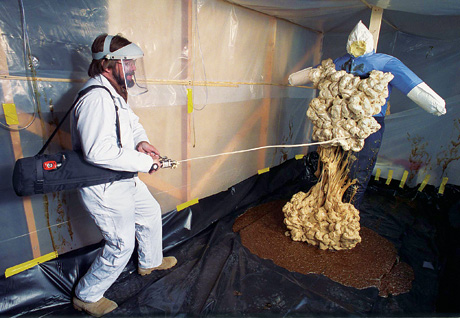
The obvious answer is that Spiderman is a fictional character, and his spider web does not exist in the real world. But apparently something rather like a "gloop gun" does exist - my thanks to Dave Rotherham for pointing it out. Wikipedia noted that:

"Sticky foam is an incapacitant, used when less lethal force is required, consisting of various extremely tacky and/or tenacious materials carried in compressed form with a propellant and used to block, entangle, and impair individuals. A National Institute of Justice-funded project at Sandia National Laboratory developed a "gun" which could fire multiple shots of sticky foam."

However, there is a fly in the ointment (an appropriate cliché where Spiderman is cited!):

"Problems with this technology include: the serious risk of smothering (suffocating) the subject; skin clean-up (the foam may not be toxic, but solvents are often harsh); "gun" clogging; targeting and firing; and gun cleaning."

A photo of deployment can be seen at the end of this blog.

In fact, it is not nearly as simple to deploy as Spiderman's web gun, which is perhaps not surprising because that is, after all, science fiction. Here's a description:

"The image of soldiers blasting away with soapy-looking foam instead of using riot batons was almost quaint. With the foam stored in silver cylinders mounted on backpacks, the sticky foam gun had a kind of campy James Bond jetpack look to it, like something from the future, if your present is, say, 1958."

"After a person has been immobilized, the sticky foam, which is made out of rubbers, resins, oils, and flame retardants, can be removed, eventually, with hard scrubbing and baby oil."(4)

The official tests have this to say:

a) sticky foam adheres immediately to skin,
b) mineral oil (baby oil) is a reasonable cleaner for removing sticky foam from skin,
c) Using mineral oil to remove sticky foam from skin requires significant mechanical effort (5)

Its deployment was not perfect; some physical force was also needed to subdue people after the sticky foam was used, and there was a potential suffocation risk

There seemed however to be no indication that Deputy Duhamel was aware of the problems with sticky foam when he was eulogising about his "gloop gun".

I sometimes get the feeling that the good Deputy has some good ideas, but he never quite manages to subject them to critical thinking before unleashing them on the general public.


No, the bearded holder of the gloop gun is NOT Deputy Duhamel!

Links
(1)   http://jerseyeveningpost.com/news/2014/04/08/fantasy-film-may-not-start-this-summer/
(2)   https://www.jersey.com/English/sightsandactivities/eventscalendar/Pages/Event.aspx?AttractionID=7987
(3)   http://en.wikipedia.org/wiki/Sticky_foam
(4)   http://cabinetmagazine.org/issues/22/mcweeny.php
(5)   http://www.aquafoam.com/papers/Scott1.pdf
(6) http://cabinetmagazine.org/issues/22/STICKY-FOAM-1_v2.jpg

Tuesday, 8 April 2014

Posting about the Past


The building above was once the HQ of the Jersey Evening Post on Bath Street, and later briefly, where Income Tax was before they relocated to Cyril Le Marquand House.

But the photo, while it looks old, is actually modern, taken this month. I've been collecting photos of St Helier buildings, especially offices and shop fronts, as a visual record of what the Town looked like in the second decade of this century.

I was enjoying an App on Kindle, which enables one to manipulate photos, and came up with this rendering, a sepia shade, with a grainy texture, but it was not an attempt to deceive anyone, just myself having a bit of creative fun.

However, looking old, as it did, brought back many memories for some of those posting comments on Facebook, and they are, I think, well worth sharing. I have made them anonymous, by removing surnames. They are fascinating little anecdotes of the past. 

Andrew: My dad was a graphic artist at the JEP for many years - in the corner of his studio behind his chair was a door that opened onto the mechanism running the clock visible on the outside of Charles House ~ mesmerising for a young boy. This was also the cupboard where "Uncle Harry" of the Junior Club kept his prizes. Loved watching the liquid metal being poured by the typesetters too. Memories... 

Denise: I remember this building as well, further up on the left hand side of this picture was a big wooden door and at the back of this area was an old wooden staircase which took you right up to the top of the building where the photographic department was. I used to run up these stairs regularly after school at Halkett Place to see my dad who was one of the JEP photographers. 

Andrew: I ran up those stairs after school too. Dad finished work at lunchtime on Thursdays & went in on Saturday morning. There was a cinema very close too 

Christine: I used to work there sending out the weekly post. I remember when Bunty Wagstaff announced to the staff his engagement to Daphne !!! Fond memories of Terry Mercury who was a proof reader back in the 70's.    

Monday, 7 April 2014

Energy Visions of the Future

"Minister's vision: Buy your own wind turbines. Islanders should adopt a Scandinavian approach to power by forming small energy communities and buying wind turbines and patches of roof-top solar panels, the Environment Minister says."
 
"The ambitious plans, Deputy Duhamel said, could see 1,000 households or more joining together to buy a wind turbine to power their homes, freeing them from the energy costs of a single mainstream supplier."(1)
 
The Jersey Evening Post reported on this story earlier this week, and I took a look at a couple of publications on the topic.
 
Ian Woofenden has written a book on "Wind Power for Dummies", and while it in theory allows someone to set up their own wind turbine, it also gives a good idea of the scale of the problem. Apart from the wind generator, the tower, wire and associated equipment for transmission and batteries for temporary storage, there are also a grid interface, metering, disconnects, overcurrent protection, grounding a more to ensure the system is safe. As he noted "There's a lot of detail to understand here, and unless you already have experience under your belt, you need support in this realm."
 
And he says "Wind energy is not a build-it-and-walk-away proposition. These systems require regular maintenance. At least once a year - and maybe twice - someone needs to lower or climb the tower to check the wind generator, do all scheduled maintenance, and address any problems. On the ground, batteries are the primary focus for maintenance, but you need to be aware of other system components and their calibration, too."
 
He explains clearly why this is the case. "Turbines live in a very harsh environment, high above the ground, where they're punished by very strong and variable winds. Turbines are rotating machines that spin, sometimes at very high speeds. Where you have mechanical motion, you'll have wear and tear". Higher than average wind speeds will increase the wear and tear, and exceptionally high wind speeds can potentially damage the turbine, as was seen on television a few years ago, when the turbine caught fire.
 
I have also been perusing a copy of "Home Power" magazine, which also looks at maintenance - "never buy a turbine solely on its up-front cost, but rather on what it will cost you over the long haul - money, time and aggravation. Wind electric systems are the toughest renewable energy systems to maintain, with the highest failure rate. Why? Because wind turbines live in a brutal environment atop 80 to 120 foot towers not readily accessible if you don't climb."
 
While small energy communities may be found in Scandinavia, where there are relatively remote clusters of dwellings for which wind power may be more suitable, Mr Woofenden comments that this is not true of all locations - "There are places where wind-electric systems just do not make that much sense - densely populated urban and suburban areas are not a great choice" Taking a map of Jersey, I would imagine that the more urban parishes would largely be ruled out.
 
And in more general matters, my correspondent Adam Gardiner had this to say:
 
"Facts and costings seem to be in short supply with the Minister's suggestion. For a start, the costs are significant --we are talking hundreds of thousands of pounds to set up a system to generate a 240volt supply. But also it should be noted that these will require qualified specialist electrical engineers and to install and maintain them."
 
"And there are other problems. What about your problems if you wish to move out from your "energy community". This raises all kinds of legal issues which have not been considered. As well as this, a prospective buyer of a property could be told they are locked into some sort of energy deal which the property is rigged up to. This could lead to all kinds of problems with property sales, especially if there are rising maintenance costs after the turbines have been in place for some years."
 
"Then there are the obvious and endless complaints. There could well be grounds for nuisance, both because of the noise, and also the visual aspect. Planning consent would be needed which at the present time precludes such a construction by virtue of the Island Plan."
 
"Who would oversee such work as to assure that a 240volt supply complied with the standards required? A vision of the future energy needs? I rather think the good Deputy should go to Specsavers!"
 
"Affordable and viable energy for Jersey is an island issue and best left in the hands of those who provide our energy needs at present as that have the expertise - and the network. That is not to say that the JEC should not be pursuing a policy of exploring our natural resources that could make Jersey more self-sufficient in the future. I should be surprised if they are not. That the States are encouraging this seems to be in some doubt. The impetus provided by the late Constable Dan Murphy seems to have ceased."
 
"But what seems to be the worst case scenario would be wind-turbines springing up ad-hoc all over the island at the expense of both the visual landscape and the ability for the JEC to invest in future technology to the benefit of the common good of us all"
 
"For my money, given we are surrounded by water and experience some of the highest tidal ranges in the world, energy from the sea seems to be the most practical and sustainable solution. I am sure it's not the cheapest option but is clearly the most reliable."
 
One thing that does come from reading Ian Woofenden's book is that Deputy Duhamel's second suggestion on solar panels may be the more viable one. It is a shame that the Jersey Evening Post's focus, concentrates on the wind power, which seems a very costly option. I noticed that in the politics hour on BBC Radio Jersey, or at least the portion I heard while driving, the Deputy was concentrating on solar panels, which was much more feasible.
 
Mr Woofenden notes that:
 
"In my 25 years of using wind and solar electricity, my PV modules have just sat on the roof doing their job. I wash them a few times a year, but other than that, I've had no involvement. In the same time period, I've had multiple wind generator failures, and my machines have all needed regular maintenance."
 
"Another bonus: Besides being simpler and more reliable, solar-electric systems are more modular than wind-electric systems. Expanding as your interest or budget allows is relatively easy (though some planning ahead is advisable if you think growth will be in your future)."
 
And he also notes that solar panels have a much wider scope in terms of placement:
 
"Many, many more people have a good solar site than have a good wind site. PVs can go on roofs, poles, and ground mounts in the city, suburbs, or wherever. Good solar sites have clear access to full sun all day, or at least for the peak hours of 9 a.m. to 3 p.m. Though not all sites have good exposure, I'd say that for every good wind site I look at, I probably look at 40 or 50 good solar sites."
 
The National Renewable Energy Laboratory in the USA provides provide monthly average daily total solar resource information on grid cells for the country.
http://www.nrel.gov/gis/solar.html  
 
And the UK Met Office does the same (albeit on a smaller scale) for the UK
http://www.metoffice.gov.uk/renewables/solar  
 
If Deputy Duhamel's vision is to be a reality, at least for solar energy, then a helpful precursor would surely be to determine which areas in Jersey would be viable.
 
There is at least one company into solar energy in the Channel Islands, the Little Green Energy Company, and their testimonials are promising.
http://littlegreenenergy.gg
http://www.littlegreenenergy.gg/Customer_Testimonials.htm
 
While solar energy is not likely to completely replace grid power, it seems to be a more viable option than wind power. It is less noisy. It may cost, but it requires far less maintenance. Perhaps there is room for at least part of Deputy Rob Duhamel's vision, after all.
 
But it would also be good to know who is now taking on the mantle of the late Constable Dan Murphy in the States in progressing work on the viability of wave power. There is no need to have all the renewable energy eggs in one basket.
 
References
(1)   http://jerseyeveningpost.com/news/2014/03/31/ministers-vision-buy-your-own-wind-turbines  
(2)   Wind Power for Dummies, 2009, Ian Woofenden
(3)   Home Power Magazine, Jan 08, Issue 122

Sunday, 6 April 2014

Fragile Life

Today at St Brelade's Church, there was a new Christening bowl dedicated at the family service; it is a gift from a family who lost their young child, age 3. There can be few things as sad as the death of a small child.

I have been to one funeral which was a cot death, of a boy a few months old. Another of a child who died of a heart condition, again only a few months old. My abiding memory is of the latter, of the father, quite a large man, cradling this tiny coffin in his arms as he processed slowly down the aisle at St Peter's Church. I can picture that still; etched on my brain.

The fragility of life came up briefly as a topic of conversation at a breakfast at St Peter's Garden Centre which I attended on Saturday. We tend to put death to the back of our minds; we probably could not function if it was there all the time.

But sometimes, we do need to be reminded. The fragility of life reminds us of how precious it is, of how each moment might be our last. Just as we cannot live in a state of euphoria or a state of despair all the time, we can't live with that knowledge either. But the danger is that we don't live with it at all; we live our lives as if we never have to come to terms with death. When Annie, my partner, died, it was the first time I had seen anyone dead. And I suspect my experience, in that regard, is not that uncommon.

Death is sanitised nowadays, and unless you want to, you don't have to see dead people. The funeral directors take care of all that for you. It is something which didn't happen in the past, where death was much more of a part of life. There's a grave with a small statue of a young boy in St Brelade's cemetery. He died around Christmas in the early 20th century, aged 10. Infant mortalitywas high, as family trees show, and death was not as taboo as it has become.

The poet Langston Hughes captures the modern attitude of shutting out death very well:

"Life is for the living.
Death is for the dead.
Let life be like music.
And death a note unsaid."

Intimations of mortality begin when your peers begin to die. My oldest school friend, from the 1960s and early 1970s, was Nigel Miles, and he must have died in the 1980s; I can't remember precisely when. I remember the funeral; it was at St Brelade's Church, and quite packed, and pouring with rain outside. Of course, not only were friends and family there, there were friends of his parents there in support as well. He must have been in his 20s when he died. He died of Aids, and of course, back in the 1980s there was a degree of stigma attached to that. Even some clergy, who should have known better, made misguided remarks about divine retribution; thankfully, none of that was present at his funeral.

There's a James Bond film on today, one of the lesser Roger Moore ones, when he was rather too old for the part of a dashing young spy. The title is "You only live twice", and in the original book by Ian Fleming, it actually has something to say about the human condition:

"You only live twice:
Once when you're born
And once when you look death in the face."

That captures something of the way in which the fragility of life can be enhanced by experiences of death, either our own, or someone close to us. As so many people have said, going to the brink of a life threatening illness, or a near fatal injury, can cause us to reassess our lives, and realise just how rich and precious life is.  As Victor Hugo says, in Les Miserables:

"It is nothing to die. It is frightful not to live."

Saturday, 5 April 2014

Weather Report

BBC News - "People with health problems are being warned to avoid strenuous activity after forecasts that air pollution will reach high levels in parts of England.  Defra issued warnings as high pollution levels were recorded on Tuesday. The pollution - a mix of local and European emissions and dust from the Sahara - is forecast in parts of south England, the Midlands and East Anglia. The pollution has caused a thick layer of dust to form on cars and buildings The elderly and those with lung or heart disease are among those warned against exercising outside."

And here is my poem about it:

Weather Report
 
Evening pink of Saharan dust
Winds carrying the sand along
Falling on the cars, leaving a crust
A fragment of a desert song
 
Breath with care, beware the dust
Its fine particles inhaled in lungs
From Southern lands, in sudden gust
Like Djinn's spell in foreign tongues
 
The smog returns to London town
Across the Thames, above Big Ben
As the desert dust is settling down
Over St Paul's Cathedral in amen
 
The weather report is a smog alert
As air pollution may well hurt

Friday, 4 April 2014

Independent Jersey Care Inquiry: A Note on the Preliminary Hearing

The Committee of Inquiry website is at:
http://www.jerseycareinquiry.org

Other blogs online commenting on it are:

Rico Sorda
http://ricosorda.blogspot.com/2014/04/committee-of-enquiry-decades-of-child.html

Former Deputy, Bob Hill:
http://bobhilljersey.blogspot.com/2014/04/independent-jersey-care-inquiry.html

Neil Macmurray
http://voiceforchildren.blogspot.com/2014/04/francis-oldham-qc-transcript.html

Laying the Foundations

I shall be reviewing the inquiry as it unfolds, but at present what has been laid out is a lot of groundwork – the foundations, upon which the inquiry evidence and assessment can be built upon. It is a good start. Once we begin to see transcripts and material appearing, we'll have a much better idea as to how detailed it will be, and how solid those foundations are. But they look very good.

And certainly the terms of reference are very wide ranging, as are the powers of the inquiry to call people before them, and obtain evidence.

First Stage: Victim's Testimony

The first stage of the inquiry is quite rightly collecting witness statements, and these are the stories which need to be told, if the victims of abuse are ever to obtain some degree of closure. Of course, like grief, closure is never complete, but knowing that your personal history of abuse is not being ignored but listened to is an important part of the healing process.

In that connection, it is important that there is adequate provision for counselling if required, as giving evidence can be an extremely traumatic experience. In the Northern Ireland inquiry, there has been criticism of "the lack of face-to-face counselling provided for those who have come forward to tell their stories," and the BBC reported that "some witnesses have been suicidal after giving testimony"

It is a shame that there does not appear, as yet, to be any links or information regarding counselling and its availability available on the Jersey inquiry website. Perhaps that can be addressed as the inquiry develops.

Phase 2: Looking at the History and Aftermath of Operation Rectangle

Looking ahead to Phase 2 of the Inquiry, I noticed this in the opening address by Frances Oldham, QC:

"We will be asking ourselves whether the policies and procedures of those organisations were fit for purpose at the time. We will also consider whether appropriate decisions were taken in deciding whether to prosecute individuals and whether there was political or other interference in those decisions."

One thing of note is "at the time". The law had not been changed in 2008 to enable the judge to abolish the rules governing evidence:

"The Bailiff or a Commissioner in the Royal Court, in a case where evidence has been given by any of the above, must always, when summing up to a jury, warn them that it is dangerous to convict if that evidence has not been corroborated in some way."

The law had been changed in the UK to allow the judge discretion over giving this warning. But in Jersey, it remained mandatory.

According to reports in the JEP, it was a conflict within the Council of Ministers over this which caused Senator Wendy Kinnard to resign as Home Affairs Minister because she wanted Jersey to move to the UK discretionary rule. Under Frank Walker's tenure as Chief Minister, the Council of Ministers actually refused to discuss this change.

That was certainly a grave error of judgement, and it almost certainly would have meant that the judgement on whether or not to prosecute was unfairly biased against a presumption to prosecute - when there was only one witness, and the rules applied.

That was changed by Senator Ian Le Marquand when he introduced the Criminal Justice (Miscellaneous Provisions) (No.3) (Jersey) Law as Home Affairs Minister, which came in March 2012, long after the cases of historical abuse had gone to court, or been judged unlikely to succeed. As Senator Le Marquand told the States:

"I am not sure that I can give Deputy Le Hérissier any specific information about the number of cases which have led to convictions in other jurisdictions as a result of the changes in the corroboration rules, but logic would suggest that the absence of the requirement for corroboration has made it easier to bring guilty men to justice and I cannot, I am afraid, say more than that."

Clearly the policy regarding this rule was lagging extremely far behind the UK, and even behind the Isle of Man – introduced 2001 – and Guernsey – introduced 2002. Why it had remained unchanged is unknown – a lack of urgency could have led to its being given low priority -  but it is almost certain that it was the increased likelihood of cases in 2008 to which it would apply was the reason why Senator Wendy Kinnard sought to have it rescinded.

We know from Senator Kinnard's resignation statement that she was attempting to bring this change in the law, and that it was thwarted. No attempt was made after her resignation to bring forward the change, under Deputy Andrew Lewis as Minister for Home Affairs. Inaction is less noticeable than action, but it can cause injustices to remain fixed in judicial systems.

Why the Council of Ministers, and in particular, the Chief Minister, were opposed to this change can only be a matter of speculation, and it is certainly a matter upon which they could be summoned and questioned. I am not going to put words in their mouths, rather they should be called upon to account for their deliberate policy of inaction, and explain themselves.

As John Stuart Mill said: "A person may cause evil to others not only by his actions but by his inaction, and in either case he is justly accountable to them for the injury."

As things stand in the historical record, what can be said is this - this deliberate inaction did amount to political interference in the judicial process. It was not a direct interference, but it was significant second order interference.

By delaying any change in the rules, it meant that it was a higher bar to decide whether to prosecute. Ian Le Marquand himself noted that "logic would suggest that the absence of the requirement for corroboration has made it easier to bring guilty men to justice." Conversely, the requirement would have made it harder to bring guilty men to justice.

Frances Oldham said in her presentation:

"The second part, to be heard in Phase 2 of the Inquiry, asks us to 'review the actions' of government departments, the justice system and elected representatives following the start of the investigation into allegations of abuse at Haut de La Garenne in 2007. We want to hear from the Ministers for Home Affairs and for Health and Social Services at the relevant time and from the Attorney General's office. Their evidence will assist us particularly in relation to the assessment that we must make of the lessons to be learnt."

It seem to me, just from the historical record, that there are certainly questions to be asked, and actions – or rather deliberate lack of action – to be reviewed.

In this context, the words Winston Churchill are appropriate on the lack of action on changing the rules until too late in the day: "Want of foresight, unwillingness to act when action would be simple and effective, lack of clear thinking, confusion of counsel until the emergency comes, until self-preservation strikes its jarring gong - these are the features which constitute the endless repetition of history."


Thursday, 3 April 2014

Limericks from Correspondents

By way of something light-hearted, here are some more limericks on local politics; these are ones that have been sent to me. I've tried to filter out what I consider unacceptable for the lightness of touch I wanted. One I did not understand in the slightest, and a few others I thought were too close to personal attacks on politicians or ex-politicians.
 
Ian Orchard gave me this one
 
Sir Pip took electoral reform
To referenda, which he hoped would transform,
The way we elect, but the only effect,
Was a turnout that was barely lukewarm.
 
Daniel Baugh followed this up:
 
There was a referendum you see
The public did vote option B
But the people in power
Were bitter and sour
And on reform, they could not agree.
 
Darius Pearce gave this one, also on the Referendum:
 
The people of Jersey they informed,
Their states, they were to be reformed
The members deranged,
decided no change
To our wishes they never have conformed
 
Ian Orchard emailed me these further ones:
 
Young Sam had designs of the States
Which despite of his lefty wing traits
Came top of the poll,
And came off of the dole
To join with the mob he berates
 
An environment minister called Rob
Has said it is part of his job
To approve bricks and mortar
For a new finance quarter
This proving himself such a nob!
 
A Minister known as Ringbinder
Backed a film he considered a blinder
But two-hundred k
Was just frittered away
Come October he'll need a reminder
 
A Treasury Minister called Phil
Gets some sort of curious thrill
Outa raising our taxes
Yet our benefits axes
Thus reducing our income to nil.
 
And this one which he sent is just a plain silly sort, but we need those too!
 
Montfort's an interesting name
And Tadier's also the same
But when put together,
One's not sure of whether
If the parents are really to blame!
(boom, boom!)
 
Daniel Baugh also sent me this one, which has a nice touch of surrealism in the fourth line
 
The lefties want things to move forward
But their policies are a little bit awkward
Political parties,
Legalise smarties
And fight until Bailhache is cornered
 
Charlie Townsend sent these four in:
 
When the Tourism Shadow Board met
They decided Jersey Tourism was wet
Tourists with buckets and spades
Creak on now with hearing aids
That market is gone for good, I'll bet
 
An Education Minister was all of a dither
And his policies seemed just to slither
On a new Quennevais School
He never laid down a rule
His plans just seemed to vanish and wither
 
There was once a Bishop called Tim
Who issued a report on a whim
Caused trouble for Bob Key
And the lady called HG
You'll never find that in a hymn!
 
A Prison Visitor told a story to the Mail
Of how she had sex in a jail
She got lots of dosh
But was it all tosh?
And just a fund raising tall tale?
 
So there we have it. Apologies for those I missed out.  I hope this raised a smile or two, even among those who were the subjects of the limericks. And what I want to know is - when will they legalise smarties? I hear they are currently banned as a "Class B Sweet".

Wednesday, 2 April 2014

There was once a States member called...

By way of something light-hearted, I have compiled a few limericks on local politics and politicians. I hope the readers find that these poke gentle fun at local politicians, and also some of the people involved in local politics.

There was a Chief Minister called Gorst
Who thought things could not get any worst
When planning did stray
But the Minister did stay
Then he thought, with that man I am cursed!

The Constable of St John was in a flurry
And exclaimed about fields full of slurry
They've polluted the water
And they really ought not to
So let's have main drains now in a hurry

Philip Ozouf made a fuss over street naming
"Non, non, non", he muttered, exclaiming
Saying that "La Rue a Don"
Should have the "La" gone
And for once, he is doing the blaming!

A BBC presenter called Price
Could be very pleasant and nice
Then like Jeremy Paxman
He became like an axe man
A lesson to politicians to think twice!

There was a bearded Minister of Planning
Thought to moving where airplanes landing
But to knock down a church spire
Was deemed terribly dire
And the idea came in for a panning.

A new law came out upon treason
Suddenly, without rhyme or reason
They said it would clear
An anomaly there
Coming early is the silly season!

A would be politician called Risoli
Said all we needed was transparency
He always said this
But votes he did miss
And his election prospects were lowly

Ron Duhamel spoke about wind power
On and on, he droned for an hour
And when he was done
Sarah Ferguson reached for her gun
And we watched the scared Deputy cower

Apologies to Rob Duhamel for the way in which he keeps cropping up, but his ideas do seem tailor made for comedy. And, just in case anyone asks, I do not believe Sarah Ferguson has got a gun, but it does make for rather a nice touch of surrealism. But I do know she's not too keen on wind power, and she's confirmed that to me.

Tomorrow I will be posting contributions which I have been sent from other people.

Tuesday, 1 April 2014

Parish plug shortfall Solution to avoid drain on municipal resources

Parish plug shortfall Solution to avoid drain on municipal resources
by Guest Blogger, Pauline Legge

The harbour at St Aubin's is full of boats once more, now that dredging operations have been completed. The sharp-eyed viewer may notice that the harbour, when full at high tide, now remains one yard below its previous high water mark. .

In a leaked report, I have learned that in the course of dredging the mud away, some historic damage to the harbour floor was uncovered. Older members of St Aubin's community may remember that here is a vast circular cast iron plug, about 3 yards in diameter, which was made to keep extra water in the harbour to enable larger boats to moor. This appears to have been damaged at some time in the past.

The first plug was made of solid oak in Elizabethan times, when Sir Walter Raleigh deemed "forsooth the waters should be retained, privy for the berth of larger vessels of trade". The money was raised by a levy on the rates. In Victorian times, the oak was badly rotting, and the Connétable stated that "des centaines de livres sont parties en fumée". A cast iron plug was made to replace it, by ironmongers, again financed by the rates.

Repairs to this plug are therefore needed, and a special early assembly of the Parish is planned for today,. April 1st,  to levy an emergency increase on the Parish rates of 1p to pay for it. After the assembly, which will be held at 11 am, there will be a traditional fish breakfast of "poisson d'avril".

Monday, 31 March 2014

Some Observations on Speech and Language in Early Years Autism

In June 1994, I wrote a piece detailing linguistic aspects of my autistic son's language at 5-6 years old, and this existed on a website which is now defunct. I am therefore putting it back in the public domain as I think it may provide at least one singular example of linguistics applied to autism, and this may be of use to other people.
 
While Martin's language did develop, during adolescence, for a variety of reasons, he exhibited what has been termed "selective mutism", and while on occasions he may speak, he rarely does so now. I addressed this in another piece which I may put up in the future.
 
The original website link has been cited in one academic article in 2010.
 
Some Observations on Speech and Language in Early Years Autism
 
Overview
 
In the following observations, speech refers to Martin's utterances [aged 5], while language refers to a linguistic description of that speech, and grammar to a linguistic description of the formative rules of language (1).
 
Using the terminology of linguistics, we will say that the grammar generates all the sentences of the language; and accordingly we do not distinguish between those sentences that have been attested and those that have not. Sentences generated by the grammar form the language and a sample of the utterances produced in normal conditions of use will be termed the corpus. Grammar so defined is descriptive rather than prescriptive.
 
This is not in any respect a formal treatise; it is a simple collection of observations. However, to observe clearly, it is important to be aware of how one is observing - what presuppositions, theories and tools are being used to help one's assessment. We have used a wide variety of different means of analysing Martin's speech, and have thought it may be useful to make the sources of these analytic tools clear by way of footnotes.
 
Echolalia
 
Much of Martin's speech consists of a peculiar form of repetition, either of complete narrative forms which he has heard (usually stories or songs) or of sentences composed of phases which he has heard
 
The narrative form of echolalia often consists of stories or songs, either from being read to, or from videos, some of which may last for ten minutes 2. They are repeated word for word, often with the same intonation as the original - Martin is very versatile at copying small nuances in speech. This seems to function as a form of entertainment. This could be seen as a substitute for imaginary play. One means, by which it can be built on, with songs, is the ability to join in singing and dancing/movement games (such as ring-a-roses).
 
The other form of echolaic utterances are generated from snippets of previously memorised speech and are mostly used for requests.
 
An example of the latter would be the question "Do you want a drink?" repeated back as a request for a drink, without the interrogatory tone of voice "Do you want a drink." Such phrases may be prompted by the question, or may be memorised from a previous occasion and spoken at an appropriate occasion later - in our example, when he is thirsty.
 
Linguistically, each phrase functions as a semiotic unit, signalling a particular requirement (3). Interestingly, this has been increasingly replaced over the last year by a primitive generative grammar (see below), but a few phrases still remain - for example "it's all right" to indicate that whatever was bothering Martin is doing so no longer. Formally, we might represent this grammar as:
 
[request] = element of set [phrase1, phrase2, .. phrasen)
 
Because of the means by which requests are made, Martin's speech shows a great deal of pronoun-reversal.
 
Limited representational skills
 
Martin has the ability to name objects, and the ability to understand that one noun can be used both for the object itself, and for a representation of the object (such as a photograph or picture). He has not the ability to form what Alan Leslie calls metarepresentations such as calling a box a boat or car, and imagining it to be so 4; there is one exception to this - a small toy rowing boat which he refers to as a "fish". Whether teaching can help him obtain such a skill is uncertain, but it cannot presume it to exist.
 
Ability to construct simple sentences
 
Over the last year, Martin has developed a very simple generative grammar which enables him to request both objects and actions 5. Although other forms exist, this is largely of the form:
 
e want [noun]
e want [action]
 
examples: e want drink, e want cuddle, e want go upstairs, e want car, e want coat on,
 
e want dummy, e want dummy back, e want try (some), e want tickle
 
Whether "e" in this context represents I or he is not known . The clarity of Martin's speech would seem to preclude a simple mispronounced "He" 6. How this form of speech developed is not known, but we have suspicions that a fellow classmate, Bradley [name redacted], who has considerably more speech, may have been using this form of speech. It is significant that more explicit pronoun reversed speech - "do you want a drink" - has been replaced by this form - "e want drink".
 
Another form, not so common is:
 
[noun - person] [action]
 
examples: mummy tickle, mummy do, mummy hug, mummy carry, mummy to help
 
There are also shorter forms:
 
e [descriptive adjective]
 
examples: e (or I'm) hungry,e (or I'm) sleepy  (this might however, be echolalia)
 
The MLU (mean length of utterance) would appear to be 3.0, although some sentences of 4 words have been spoken recently. This is an increase over a year ago, when the MLU was 1.0 (in naming pictures).
 
These forms of speech are predominately becoming the preferred form for request, and have clear advantages over the echolaic phrase-created speech in that, although still primitive, it has superior generative power.
 
His phrase-created speech was limited to utterances heard and was simply generated by choosing from a set of stock phrases, while this form of grammar can, in principle, generate new sentences not heard before.
 
Further observation is required before we can determine the extent of the element of novelty in his speech, as we have not been keeping sufficiently accurate records to determine this; however, our hunch is that he has spoken at least several new sentences.
 
A recent report on Martin by Julia Hare described his speech as being largely phrases composed of "chunks of language"; We find this description somewhat vague, as it does not differentiate between (a) the older phrase-created grammar (b) the simple generative grammar 6a. The importance of the latter is both that a genuine sentence (although primitive) is being generated, and that the generative abilities of the grammar are superior.
 
As far as the use of the odd term "e", this might be altered to "I", by deliberately increasing the usage of personal pronouns by parents and/or speech therapists while talking to Martin. As Michael Rutter has noted, it is often the case that everyday speech does not contain a great use of some personal pronouns, such as I.
 
There has been a marked progression from phrase-created speech to a primitive generative grammar, but as future progress, if it occurs, will most probably build on and improve the existing generative rules, we will try to keep a written record of utterances, and if possible, by taking samples (over the odd day), also try to ascertain the frequency of particular types of request.
 
Ability to differentiate objects
 
Martin will ask for objects (often with related actions), such as a drink or a story or a video. He can then understand and reply to a supplementary question which requires him to differentiate further between types of the same object.
 
Example 1:
 
M.:       e want drink
Q:  What sort of drink do you want?
M: e want orange
 
Example 2:
 
M:        e want Thomas (request for a video)
Q:        Which Thomas?          (which tape, there are 6-7 tapes, some compilations)
M:        e want Trevor (the only tape to feature Trevor the Traction engine)
e want Fishing  (the only tape to feature Thomas goes fishing) etc.
 
Example 3:
 
Q:        Which book do you want?      (the last bedtime story, usually Thomas)
M:        e want Thomas
Q:        Which Thomas?
M:        e want Saved from Scrap        (Saved from Scrap)
e want Trouble (Thomas in Trouble) etc.
 
This is demonstrating a rudimentary grasp of making choices, albeit prompted choices, and an ability to find a characteristic of an object which differentiates it from other objects of the same kind.
 
Conclusions
 
Language related to co-operation.
 
There seems to be a possibility for using songs, rhymes and related dances/movements for getting Martin to participate in games with others, and by so doing to learn to relate to others.
 
Words and actions
 
There seems to be a clear development from language generated by choosing from a set of existing phrases and the primitive generative grammar which is capable of creating genuinely new sentences.
 
It is noteworthy that the generative rules allow many different requests to be made for a relatively small investment - the verb "want" is very useful in this respect. If it were possible to encourage other such verbs (e.g. "have"- e have headache, nosebleed; "come" - Mummy come, Daddy come, "go", "wash" and other actions), this could increase the generative abilities of the language.
 
This could be done by prompting and fading techniques, where actions (pointing, commands) are talked through and mirrored by physical cues initially, then these cues are reduced.
 
Words and choices
 
The generative grammar is still a long way from the transformational rules evident in everyday speech - e.g making a question from sentence. or vice versa. Although anecdotal, it is interesting that Tony observed his niece's speech develop from a simple generative form based around the verb "do" (Mummy do, [name redacted] do etc.) quite rapidly to a transformational form (What mummy do? What daddy do?) well before other verbs and nouns came into the equation (7). The use of yes and no to indicate preference is also poor, at least with yes!
 
We would surmise that the initial stages transformational grammar is dependent upon a desire to find out motivations for actions; the evidence would be that autistic children have a deficiency in this sort of curiosity. But it is not beyond the bounds of possibility that both educational activities - particularly group activity - and speech therapy - might foster an increased awareness of "other minds".
 
Deficiencies in Speech
 
While Martin's vocabulary has grown, and the patterns of his speech have impoved, there are still notable deficiencies in his speech:
 
1) the absence of "yes" or "yes, please" to answer a question.
2) an inability to use speech for a good many requests, in which case, he will use hand-holding prompts to direct you to what he requires. Here, we in turn, use this as an opportunity for prompting and fading techniques.
 
Also, while he appears to always build on the language and grammar already acquired, we have observed that his use of language varies in a cyclical manner, from periods of advance when both the pattern and vocabulary show a noticable increase, to periods of withdrawal, when speech becomes noticably more limited in usuage.
 
At the present time of writing, he shows reluctance to differentiate between objects by speech, although this was very notable a month ago. If the pattern is cyclical, we would expect this to return in a month or two. The reasons for this phenomena are unknown, but we think that such times may be spent assimilating language skills after the effort required in acquiring them.
 
Future Prospects
 
As far as speech is concerned, we would hope that the greater the power of the generative grammar used by Martin, the more his understanding of the world will increase, and this in turn may (with teaching and luck) feedback into an improved and more powerful grammar, in which he might use his speech for other than simple requests 9.
 
June 1994
 
Notes
1. This follows the basis for describing linguistic phenomena laid out by N. Chomsky (Syntactic Structures).
2.         Here Martin follows very much the form of speech described as recitations and performances by Katherine Loveland (Narrative Language in Autism )
3.         On the signalling function of language, c.f. K Popper (The Self and Its Brain). While the M.L.U. of such utterances is obviously greater than 1, the more useful linguistic string length of a sentence is only 1,as each utterance can be described as a single token in a sentence.
4.         c.f. Alan Leslie and Daniel Roth (What autism teaches us about metarepresentations).
5.         The formal structure of generative grammars is set out in Chomsky (Language and Mind). Martin's speech displays a very poor finite state grammar, as it does not involve recursion, but can be described by a set of states moving from left to right.
6.         There is the possibility that it is an amalgam, a created word fused from several pronoun parts (I/me/he). Note that Martin will repeat "This old man, he played one etc" with a clearly enunciated "he" and not "e". Rita Jordan has pointed out problems with assimiliation of referential deixic labels.
6a.       More formally, we would say that (a) the pattern of gramatical structure has altered, and (b) the mean string length of a sentence in the language has increased. Note that Lorna Wing distinguishes between echolalia (immediate and delayed) and immaturity of grammatical structure of spontaneous (not echoed) speech (Communication, 1972).
7.         Tony has since found his "hunch" that this is common confirmed in part by various observations made by Helen Tager-Flusberg about the very early speech of normal and autistic children (What language reveals about the understanding of minds in children with autism). On transformational grammar, c.f. Chomsky, Op.Cit.
8.         c.f. Michael Rutter (The Treatment of Autistic Children).
9. c.f. Michael Rutter, Op.Cit. where the ability of language to suddenly emerge in some case-studies of autistic children is described; from this, it would appear that language acquisition might be well modelled mathematically by a catastrophe surface , c.f. Ian Stewart (Mathematical Realities) for examples of such models. Tony has since found a discussion of this by the mathematician and social scientist Jean Petitot (Localist Hypothesis and Theory of Catastrophes).
 
Appendix: Phrases Currently in Use:
 
This is a list of phrases used largely over one weekend; it is not comprehensive. Explanations are placed in brackets after the sentences; italics in the sentences themselves indicate that the word is pronounced unusually.
 
Phrase-Created Grammar
 
you've finished            (I've finished, e.g. a meal)
you've had enough      (I've had enough)
it's all right       (I'm alright)
no - ok!            (I do not want to do that!)
more tickle       (I want a tickle/hug/affection)
it's a naughty cough     (commenting on his coughing)
mummy's pocket         (what's in mummy's pocket - a biscuit or dummy?)
hello Martin how are you         (used to reduce stress)
 
Generative Grammar:
 
Food and Drink
 
e want mummy's coffee
e want drink
e want orange
e want milk
e want try some
e want sausage
e want chippies
e want milky bar
e want biscuit
 
Medical
 
e want Calpol
 
Toys
 
e want Thomas
e want boat      (a toy boat)
e want fish       (a toy rowing boat)
e want birdy     (toy penguin, mother and spring-pull attached baby)
e want that       (pointing to/indicating an object out of reach)
 
Clothing
 
e want hat
e want coat on (but this may also mean "I want to leave/go out")
 
People
 
e want mummy
e want daddy
e want granny
e want popa-pete
e want brother
 
Bedtime
 
e want draw blind (on his bedroom window)
e want go to bed
e want cot
e want duvet
e want snuggle down
e want light off
e want light on
e want close door
e want music
e want gate       (stairgate)
e want a story
 
Going Out/Returning Home
 
e want coat on
e want go in car
e want go in garden
e want go outside         (garden)
 
At Home
 
e want come on mummy's lap
e want sitty on chair
e want to come out      (when sitting on chair)
e want turn it off          (music cassette/tv/video)
e want picture  (a framed photograph he likes)
e want Nursery Rhymes           (request for video)
e want Thomas            (request for video)
e want Postman Pat      (request for video)
 
General
 
e want mummy to do
e want dummy
e want dummy back (when taken away, particularly after having medicine)
mummy to do
mummy to help
e want mummy's glasses          (mummy is to put on her reading/sun glasses)
it's daddy         (on seeing daddy from window)
 
Questions
 
what he's doing(?)        (possible question about his brother)
 

Sunday, 30 March 2014

Myths of Mothering Sunday

"Mid-Lent Sunday.-In the Stroud and Minchinhampton districts, servant girls still expect to go home for "Mothering Sunday"; they generally take a cake with them. Cakes are sold in the Stroud shops for the purpose; so, too, in Bristol. At Randwick, married children go home to visit their parents. Round Haresfield, veal is eaten on this day" (Cotswold Place-Lore and Customs, 1912, J. B. Partridge)

"At Bury, a day of great feasting and rejoicing is kept in mid-Lent, and goes by the name of Mothering Sunday. The people come from far and near to visit their friends at Bury, and are entertained with "Simnel Cakes" and ale.  The shop windows are full of a particular kind of tempting cake, well sugared on the top, and made in every size, and these are the Simnel Cakes" for which the day- is famous). (The Irish Monthly, Rosa Mulholland, 1882)

There's a line of though that I've heard in sermons in the past, although less of late, that Mothering Sunday has to more to do with "Mother Church" and the connection with Mothers is a late afterthought. It is perhaps an understandable reaction to the range of cards some of which say "Mother's Day" and some of which say "Mothering Sunday", and of course all the meals, presents etc, all related to mothers - the Mother Church doesn't get much of a mention.

But I think that's a very bad idea, as if the idea of "Mother Church" could somehow be divorced from the universal idea of motherhood.

It happens to some degree in America, where for some strange historical reason, they have a "Mother's Day" elsewhere in the calendar. That's because the traditions had become moribund, and when revived, the appointed date was fixed elsewhere on the 2nd Sunday in May. As Ronald Hutton describes in "Stations of the Sun":

"Miss Anna Jarvis was well-connected enough to turn her personal obsessions into public laws, and her tireless lobbying caused the Senate and House of Representatives of the United States to legislate in 1913 that the second Sunday in May should be set aside as a national day of remembrance of mothers. It seems to have been the arrival of American soldiers in the Second World War which introduced the concept to England, where the memory of the old Mothering Sunday was still strong enough for the two to become merged."

So where did the original festival come from? There are a good many false leads, just so stories, often without firm historical evidence. One popular one is that this was a day in which people returned to their mother church, but the evidence for that is not well grounded.

The Book of Common Prayer at this time has a special Epistle on maternal love.  Galatians 4:26 states that "Jerusalem which is above is free; which is Mother of us all." But there is no indication in Cranmer's work of any special festivity for this day. It may well be that the idea of returning to a mother church was derived from this verse, rather than any historical practice of the past.

In fact, how and when Mothering Sunday came into the Christian year is another matter. If there was a pre-Reformation celebration of that name, it has left no trace in the sources, which is certainly an oddity. One would expect some mention of it, but there is none.

The earliest historical reference seems to date from the 17th century, and Ronald Hutton notes that:

"The earliest certain reference to it is in the journal of the royalist officer Richard Symonds, for the year 1644: 'Every Mid-Lent Sunday is a great day at Worcester, when all the children and godchildren meet at the head and chief of the family and have a feast. They call it the Mothering-day'. "

"To Symonds, an Essex man, the tradition was unfamiliar, and he did not hear of it elsewhere on his marches across southern England. Probably earlier still is the poem by Robert Herrick, published in 1648 but written at any time in the previous twenty years:"

I'le to thee a Simnel bring,
'Gainst thou go'st a mothering,
So that, when she blesseth thee,
Half that blessing thou'lt give me.

That is a reference to a Simnel cake, which as Bonnie Blackburn notes in "The Oxford Companion to the Year":

"It is an old custom in Shropshire and Herefordshire, and especially at Shrewsbury, to make during Lent and Easter, and also at Christmas, a sort of rich and expensive cakes, which are called Simnel Cakes. They are raised cakes, the crust of which is made of fine flour and water, with sufficient saffron to give it a deep yellow colour, and the interior is filled with the materials of a very rich plum-cake, with plenty of candied lemon peel, and other good things."

Hutton maps out the domain of counties in which a Mothering Sunday was observed, and it seems to have its origins in a fairly localised cluster of countries, and from thence to have spread out and become more universal as part of the Church of England's Christian calendar.

He notes the context of the festival seems more to have originated in familial than religious practices. It was the occasion when children who had gone to work as apprentices and domestic servants were given a day off to visit their mothers and families. As he notes:

"Mid-Lent would have been an excellent time for families to remeet and inform themselves upon each other's needs, when the conditions for travel were improving after winter and want would be greatest. Widowed mothers would have been especially vulnerable. In addition a cue may have been given by the epistle for that Sunday recommended in the Anglican Prayer Book: ' Jerusalem Mater Omnium'. "

This goes back to the medieval name for the Sunday of "Laetare Sunday" from the same epistle. But Hutton warns against reading too much back into the sources.  Although it had the name "Laetare Sunday" and seems to have been a day off the rigours of Lent, it went by many different names - Refreshment Sunday, Mid-Lent Sunday (in French mi-carême), and Rose Sunday.

One of the earliest liturgical notices of the extra day of Lent such as Laetare Sunday" occurs in the special Gospels assigned to them in a Toulon manuscript of 714. This notes that this was a special festival in Lent in which flowers were permitted, the organ could be played at the Divine Service and Vespers; rose-coloured vestments were allowed instead of purple. There is no mention of motherhood or processions!

Post-reformation, we have a sermon by Luther on the Loaves and Fishes (the Gospel reading) which emphasised the name "Refreshment Sunday". Interestingly the Lutheran church kept the tradition of rose-coloured or pink vestments.

As Hutton concludes:

"A long-established argument, that the custom also derived from a medieval rite whereby parish congregations processed to their 'mother church' (the cathedral of their diocese) upon this day, remains unproven."

But unproven, it has nevertheless become the religious narrative of choice, despite the lack of sources to support it; it is stated as a fact. For example, one website says:

"Centuries ago it was considered important for people to return to their home or "mother" church at least once a year. So each year, in the middle of Lent, everyone would visit their "mother" church, or the main church or cathedral of the area."

And another notes:

"A popular notion is that Mothering Sunday was an occasion when, in the 18th and 19th centuries, domestic servants were given the day off to visit their mothers and the family home. What is far more likely is that the gathering of families on Mothering Sunday was due to the older custom of going together to the Mother Church. ""

These are always vague pieces of folk-lore, with no sources, occasionally we are told "historians say", but lack anything substantive. Unfortunately such is the power of transmission of unverified ideas that this is taken as factual. It is at least as likely that the reverse is the case, and the domestic customs became entwined with the Lent and given religious overtones in a story back projection. What went simply under the term "Mid Lent Sunday" became "Mothering Sunday". Indeed, writing in Folklore (1961), Violet Alford went so far as to say that "Churches have annexed the day".

By way of demonstration of the variety of imaginative speculation, another website comes up with an explanation which is at least as plausible:

"England's Mother's Day observance goes back to the 13th century when "Mothering Sunday" was observed on the fourth Sunday of Lent (because it was originally for Mary, mother of Christ)."

Given the way in which the cult of Mary was more or less extinguished after the Reformation, this is at least as likely as tales about processions.

The situation is complicated further, because the Mothering Sunday traditions were moribund and fading fast when revived in America, because Anna Jarvis had a residual folk memory of the tradition in England. But when it returned to England, it focused on the existing festival day, and strengthened a religious narrative. As Christopher Howse explained in "The Telegraph":

"The British tradition grows a little complicated. For the revival of Mothering Sunday must be attributed to Constance Smith (1878-1938), and she was inspired in 1913 by reading a newspaper report of Anna Jarvis's campaign in America."

As the Oxford Dictionary of Nation biography notes:" Smith recorded disappearing folk customs and unusual local church traditions and recipes connected with the day, such as the Simnel cakes made in Shrewsbury, Bury, and Devizes and the wafer cakes baked in Chilbolton, Hampshire."

But it is in the revival that it took on its very modern form. As Christopher Howse notes:

"Constance Smith was a High Anglican who believed that "a day in praise of mothers" was fully expressed in the liturgy of the Church of England for the fourth Sunday of Lent. This is not entirely the case, for the Collect on that Sunday asks God that "we, who for our evil deeds do worthily deserve to be punished, by the comfort of thy grace may mercifully be relieved". That doesn't sound specifically maternal."

"Under the pen-name C. Penswick Smith she published a booklet The Revival of Mothering Sunday in 1920. Things snowballed, impelled by feelings consequent on the loss by many mothers of their sons in the First World War."

"Constance Smith's idea was not that Mothering Sunday should be limited to one Christian denomination, and its popularity spread through such open organisations as the Boy Scouts and Girls Guides. "By 1938," wrote Cordelia Moyse, the modern historian of the Mothers' Union, "it was claimed that Mothering Sunday was celebrated in every parish in Britain and in every country of the Empire."

Just as Victorians such as Dickens reinvented Christmas and gave us many of the trappings that we have today, it seems likely that Mothering Sunday, as a Christian festival, owes much to the religiosity of Constance Smith. That's not to say that is a bad thing. It is good to bless mothers. But the notion that it has nothing to do primarily with mothers fits badly with the historical evidence; if anything, it is the Christian reinvention which is more modern.

Having finished this, I was gratified to read Liz Lambotte, Youth Worker at St Aubin Methodist Church, writing in the JEP and getting the history spot on about the 17th century origins. She also has this to say, which I think is also extremely good:

"Mothering Sunday provides us with a wonderful opportunity to give thanks to all the women who have cared for us, not just those who have brought us into the world, but those women who love us and have nurtured us along our journey, those who have stood up for us, believed in us and showed compassion."

Saturday, 29 March 2014

More Saturday Limericks

The "Friday Poetry" group, of which I am a member, had for two weeks, the  theme as "Limericks", in honour of St Patricks's Day.

As I noted last week, the limerick is a nice form, because you can be silly and surreal, or you can actually be real but succinct, but there is always pretty well always an overtone of fun because of the form. Here are some more of mine for your amusement:

Last weeks can be read at:
http://tonymusings.blogspot.com/2014/03/saturday-limericks.html

I begin with a few Limericks based on real people. The first is somewhat humorous, about Heston Blumenthal, who produces all kinds of strange and exotic recipes - like snail porridge - at his restaurant "The Fat Duck", and people pay quite high prices to eat them!

There was a strange chef called Heston
Whose food confused the intestine
He made snail porridge
Which he kept in the fridge
And found willing diners to test on


In the second case, I look at a topical news story. In that case, the limerick has a touch of irony to its brief comment about the effectiveness of the response to Russia.

There was a Russian called Vladimir
Whose name was a byword for fear
He annexed the Crimea
And wept not a tear
While politicians just said "oh dear!"


The simplest limerick is the silly one, and this is based very loosely on the old saying "patience is a virtue, virtue is a grace, grace was a little girl who didn't wash her face". So here is a tale about that little girl.

There was a young lady called Grace
Who hardly ever washed her face
But her skin was pure
And she looked demure
Especially wearing gowns of lace


And here are a few other light, and rather silly ones. Although I think, many people have met the trendy young Vicar at some time or other in their lives.

There was a trendy young Vicar called Dave
Who embarked on a Mission to Save
Most people did flee
From his third degree
And ran off when he gave them a wave.

A church mouse was quiet as the grave
And used to live over the nave
Until one fine day
He decided to stray
A cat ate him, and he's now in a grave!


And on to fairy tales, and the one about Rip Van Winkle. "Rip Van Winkle" is a short story by American author Washington Irving published in 1819 as well as the name of the story's fictional protagonist. In the story Rip goes into a hollow in a mountainside, drinks moonshine, and awakes 20 years later. It's a myth that has been told of other characters, of course, but this is a distinctly American rendering.

A young man called Rip Van Winkle
Whose eyes had a merry twinkle
Went into caves deep
And fell in deep sleep
And awoke old with skin full of wrinkle


And my final one is from "The Hobbit, or There and Back Again" by Tolkien, the precursor to "Lord of the Rings", and currently being shown in a series of movies at the cinema:

There once was a Hobbit named Bilbo
Who went off to fight many a foe
He faced a dragon
Drank beer from a flagon
And far there and back did he go

Friday, 28 March 2014

Letters to my Grandchildren by Tony Benn (2010): A Review

"There are four questions which, although simple, and even child-like, get to the heart of the problem and offer a way for adults to act. Where there is injustice, the first question is: who gave one person the right to do harm to another? That is a revolutionary question which is directed at authority itself and the sources of power which sustain it. Then comes the question: what is going on? It is often a difficult one to answer but it is also an important one because if you do not understand a situation you cannot influence it. The next question is: why is it going on? It forces you to think about the nature of society and how it works. What can you do about it? is the most difficult but also the most important question of all." (Tony Benn)

One of the shortest publications to come from the pen of Tony Benn is the book "Letters to my Grandchildren". It's not nearly as long as the volumes of his diaries, having a bare 164 pages. Each section is very short, as if it was in fact, a letter. And over the course of this book, he covers many issues.

The tone of the book is very different from the diaries, however. It's like a grandfather gently reclining in a chair, with slippers on his feet, puffing away on his pipe; it is a warm and chatty style. Here is an example, and note how he takes the amusing letter from the constituent to raise a chuckle before moving on to the serious question of new technology and the moral questions it raises.

"When your parents were your age, and the United States and the Soviet Union were racing to land on the moon, the Russians put down a little robotic machine onto the lunar surface. One of my constituents in Bristol, where I was then the MP, wrote to me: "

"Dear Tony,

I see the Russians have put a space vehicle on the moon. Is there any chance of a better bus service in
Bristol? "

"It was a very good question. "

"From the beginning of time to the days when your future great-grandchildren are born, the choice is and will always be: what do you do with the technology you have? Is it for peace or war? Does it divide people or help to bring them together? And what effect could it have on the human race's capacity to govern itself peacefully? The uses made of technology thus raise fundamental, moral issues."

These letters are finely crafted, rather like secular sermons, and they begin like this, with a homely anecdote as the hook to take the reader into the actual point which he wants to make. The difference, of course, is that these are secular, although one feels the prophetic overtones bubbling away under the surface.

Technology is often a key feature of these letters, perhaps reflecting that he himself was once Minister for Technology, and oversaw the opening of the Post Office Tower; in its day, this was a marvellous leap forward in telecommunications.

And he looks at the technological revolution of the internet, and how it has fundamentally changed how information is controlled.

"All of you grandchildren, like everyone of your generation, take the internet and its social possibilities for granted. The technicalities of using it are hard for parents and grandparents to master but it has helped to create the best-informed generation in history and gives you freedom to exchange information and compare interests across the world. This very fact has made it a deadly threat to the powerful. Throughout history control of communication and information has been crucial to political control. Dictators use that power over information to dominate their people even if there is no provision for democracy."

It's not wholly true, of course. Secrets are still kept behind locked doors of governments, and it is sometimes hard to ask the question to open that door, and manage to get an answer. The internet has also become so swamped by data that there is also an awful lot of misinformation out there. It can be difficult sometimes to know where truth lies, although outside of David Ike's forums, you are unlikely to get much credence for supposedly eye-witness accounts that Ted Heath was a shape shifting alien, which is something which Ike himself seems to believe.

But what the internet does do extremely well is to widen terms of debate, and open up news sources that would have been in the past constrained by the editors of the great newspapers, and the magnates who owned them.  That can be both a blessing and a curse. If one considers the abdication crisis, the UK newspapers first kept the story out of circulation, and then the government and newspapers shaped the debate. They can still attempt to spin stories, but other voices can be heard, and other historical narratives offered.

And here is another opening which grabs the reader. He takes the global reach of travel, and uses it as a hook to open people's eyes to the places they visit - and the political regimes in charge.

"You think nothing of jumping on a plane and going to Beijing, or Nepal or Tehran. But when you arrive in any country, you should always ask yourself, `Who runs the joint? Power in the world has always been exercised by a tiny handful of people with their gangs of followers, and it is very easy to see what their interests are - to hang on to their wealth and power and increase them wherever possible."

This is perhaps an over cynical view of the world, and it is not altogether clear how much power can be exercised by individuals, and how much comes from market systems which may be beyond anyone's ability to control. It is notable, for instance, that examples of that, as with the credit crunch, are rather conspicuous by their absence. And political regimes do collapse, and on occasion, as in Russia, quick rich businessmen can find their wealth is no safeguard against brute political power.

Nevertheless, the questions about who runs a country, who is in charge, and how they hold onto power is still one worth asking. Power can easily become a vice, a magnet drawing people in, and those who enter politics with the best of intentions can be corrupted by the desire to hold onto the reigns of power.

Nothing is perhaps more pitiful than a politician who was in power, but who has fallen from the charmed circle, suddenly coming to the realisation that power resides in an inside group, and he is no longer part of that; it is pitiful, because they invariably never saw that while in office, and one strongly suspects that should they be in a position of power again, all those doubts and criticism would melt away like morning dew. But what they do show, and show very well in their resentment, is that there is invariably a charmed circle of some kind, which draws a ring around its deliberations, and keeps backbenchers at arms length. I think that's true of even those who espouse consensus.

Most of the letters also look back on history, and take lessons from the past into the present. There's an interesting one on slavery, which looks at the abolition of slavery, but also looks at the different degrees in which slavery persists today. Some of this is to a degree metaphorical, as with debt slavery, but some of it is still very much a throwback to slavery.

People trafficking, which mostly effects women, is something that while illegal, still persists in its own very black market. And while Lord Shaftsbury worked to implement the Factory Acts in Victorian society to restrict and eventually outlaw the exploitation of child labour, we are often still happy to get cheap consumer goods from distant lands, and not give the sources of those goods the scrutiny which they deserve, where childhoods are being stolen:.

"In industrial society, workers are to some extent at the mercy of their employers and might be sacked if they oppose or question their conditions of employment; if they have mortgage and cannot make the repayments, their home: may be repossessed. So debt slavery is also a form of control. Of course, we believe slavery to have ended and imperialism to be history, but there are two new forms of slavery that have developed in your lifetime: the hideous trafficking of women for prostitution and the completely unacceptable use of child labour to produce cheap consumer goods for the richer countries."

It is interesting that Tony Benn's vision of workers, while heavily critical of large businesses which can use their economic leverage to protect their global interests, is strongly in favour of small businesses. What he means by workers are not just those employed, but employers who also work very hard for relatively little return:

"When socialists talk of workers, they must necessarily include small businesses, not only the ones that produce new ideas, but also the shopkeepers and organisations that meet most of your daily needs, and are run by people who work very hard, whether in a newsagent or a small engineering factory and do not have teams of accountants and public relations officers to market their goods."

"The small business that innovates, develops and markets new products - as Nahal will know - or meets local needs efficiently, has to be regarded as the pioneer of the new technology and deserves public support and indeed backing from the labour movement."

"A real political problem arises when it gets so big that it becomes a force of its own, using its influence to control governments. This is even more true of multinational corporations that have no local roots and are rich enough and strong enough to campaign to protect their economic interests against governments and parties that are much less well financed."

On elections, he is firmly in favour of the Single Transferable Vote as the fairest way to conduct an election, but he also has an interesting point to make about candidate's interests, which I think would be of great benefit, not just in the UK, but also locally:

"The register of members' interests which was established some years ago should be extended to become a register of candidates' interests, for electors are entitled to know the interests of all candidates before they are elected rather than after."

On cabinet government, and collective responsibility, he thinks too much power is in the hands of the Prime Minister: "Government ministers are subject to even tighter control than MPs because their employer is the prime minister who has the absolute right to dismiss them"

That can mean that the Government Minister has a strong structural bias to support the Cabinet, whereas Tony Benn sees the responsibility of all members of Parliament quite differently. He would like more power to devolve back to Parliament. Jersey is, of course, heading in the opposite direction in this, with the new proposition about collective responsibility, and an increase in the power and patronage of the Chief Minister.

Tony Benn is speaking, of course, of a Party System, but it is, I think, a good illustration of the balance between different responsibilities faced by a member of Parliament, and how you have to weigh them up:

"I can think of no greater honour than serving as an MP, and the relationship between you and your MP must be one of trust, for in democracy sovereignty belongs to the people and they merely lend their power to those who represent them. An MP's first responsibility is therefore to constituents. "

"The second responsibility of an MP is to the local party, who can select - and deselect -- the candidate and must trust whoever they do select to work honestly for the policies to which they are committed. MPs also have a general responsibility to the party of which they are members. "

"Finally and most importantly, MPs have a responsibility to their own conscience, which may on occasion lead them into conflict with their local or national party or even into voting against the majority opinion of their constituents."

There are homely anecdotes throughout, and one thing that becomes clear is the importance of contact with the constituents who elected you. This is something which is a vital part of being a member of Parliament, although it often goes on behind the scenes in Jersey, as in the UK.

I was impressed, recently, and privileged to hear of some of that work done (from a constituent) by Montfort Tadier, and doubly impressed because I know he has made no political capital of this behind the scenes helping his St Brelade constituents. I know that Deputy Judy Martin and Deputy Geoff Southern also do a lot helping people who are struggling with income support forms. This is not showy, of the kind of work that gets you on the BBC Radio slot, or a picture in the JEP, but it is the backbone of democracy.

I'm sure that, far from being idle, many Deputies do a lot unseen and confidential, and often in evenings when people are free. Just because a Deputy does not blow their own trumpet, does not mean that they don't work hard for those they represent.

I know from my own experience when Deputy Graham Huelin helped our family that a lot of this background work goes on. Those who think that all Deputies are largely idle wasters - and I have seen that accusation several times - are speaking with the confidence of ignorance. There are idle Deputies, and I could name a few, but to tar all with that brush is unjust.

Tony Benn gives an anecdotal insight into his surgeries, and how they worked:

"The surgeries became almost like a psychotherapy session. One elderly man on crutches asked me to help him prosecute his teenage son and, with gentle questioning he poured out a whole series of incidents. I asked him at the end, `I wonder whether possibly you are a bit jealous of your son?'  His attitude changed and he clapped his thigh, shook my hand and said, `Mr Benn, I believe you are absolutely right.' He picked up his crutches and walked out. "

"I have given a lot of thought to the work of a local member of parliament and have come to the view that much of the casework fell into the same category as the palliative care offered by hospices. Support was needed whether or not you could actually solve the problem for a particular constituent. The people who wrote to me or queued up at my advice centres to tell me their stories, wanted to be heard and they wanted me to listen."

The letters end on a note of humility, and warmth, as he looks back on his life, and takes stock of the future, with hope. Despite everything, he remains an optimist:

"Living as I do `in a blaze of autumn sunshine' I realise I have learned more from my children and grandchildren than I did from my parents and therefore look with love .and thankfulness on the human family. It seems appropriate to end these letters in a spirit of love and gratitude and sign myself off"

I think that long after the diaries have collected dust on the bookshelf, forgotten except by historians piecing together different perspectives on our age, this small little book will still be read. It does not provide answers, so much as questions; but in doing so, it raises matters which we and our children and grandchildren will need to address.

This is not the whole Tony Benn. The tearing apart of the Labour party, and the Manfesto described as the longest suicide note in political history (and the terrible election defeat which followed), and Benn's active involvement in them is not to be found in his historical anecdotes or his comments about Government and the Labour Party.

Also the misplaced support he gave to the Militant Tendency, the movement within the Labour party which used the threat of deselection to try to  manipulate members of Parliament as puppets is also not present. Lessons could be taken from those, but no letters address those matters.

That matters, in terms of assessing the political legacy of Tony Benn. But this book is not about that political legacy. It is not an examination of a life, or an autobiography. It is not a political tract. It is more of a statement of faith, of optimism and hope in the next generation, and, as the subtitle puts it, of "Thoughts for the Future".

And regardless of whether we regard Tony Benn as a dangerous maverick, a National Treasure, a ruthless operator (as Jack Straw described him), or a determined democrat, the matters which he raises are important issues. I'd recommend this to anyone, especially young people, to look at those issues which are presented here in a clear style which is certainly reminiscent in many ways of George Orwell or C.P. Snow. It is very readable, almost chatty, and never boring.