Thursday, 17 April 2014

Maundy Thursday

 "The 1948 Palestinian exodus occurred when approximately 711,000 to 726,000 Palestinian Arabs fled or were expelled from their homes, during the 1947-1948 Civil War in Mandatory Palestine and the 1948 Arab-Israeli War. The exact number of refugees is a matter of dispute. But around 80 percent of the Arab inhabitants of what became Israel..Later, a series of laws passed by the first Israeli government prevented them from returning to their homes, or claiming their property. They and many of their descendants remain refugees." (Wikipedia)
 
Thinking about the plight of the Palestinians prompted this poem. The decision to expel them may not have taken place in an upper room in Jerusalem, that is a matter of poetic licence, but it probably did take place behind closed doors.
 
It is one of the ironies of history that the Jewish peoples, in exile for so many years from Israel, should in turn send the Palestinian people into exile, especially as they are genetic cousins. And sadly power games still dominate Middle Eastern politics today, as they did outside an upper room two millennia past.
 
Maundy Thursday
 
Upper rooms in Jerusalem
And behind closed doors
Talking about "us" and "them"
Hate leaves residual spoors
 
Palestine behind barbed wire
An exiled people, driven out
In poverty they live so dire
Why do not the hills cry out?
 
Upper rooms upon one day
Washing feet, a servant song
Another choice, another way
Instead another path so wrong
 
These power games forget the poor
When will it end, and be no more?
 
 
Notes on Genetics:
 
Tomas Rees commented in 2009 that:
 
 "The genetics of Arabs and Jews have been pretty extensively researched. The classic study dates to 2000, from a team lead by Michael Hammer of University of Arizona. They looked at Y-chromosome haplotypes - this is the genetic material passed from father to son down the generations. What they revealed was that Arabs and Jews are essentially a single population, and that Palestinians are slap bang in the middle of the different Jewish populations."
 
"Another team, lead by Almut Nebel at the Hebrew University, Jerusalem, took a closer look in 2001. They found that Jewish lineages essentially bracket Muslim Kurds, but they were also very closely related to Palestinians. In fact, what their analysis suggested was that Palestinians were identical to Jews, but with a small mix of Arab genes - what you would expect if they were originally from the same stock, but that Palestinians had mixed a little with Arab immigrants."(1)
 
The geneticist Harry Ostrer showed more linkages:
 
"The Law of Return, the Israeli law that established the right of Jews around the world to settle in Israel and which remains in force today, was a central tenet of Zionism. The DNA that links Ashkenazi, Sephardi and Mizrahi, three prominent culturally and geographically distinct Jewish groups, could conceivably be used to support Zionist territorial claims -except, as Ostrer has pointed out, some of the same markers can be found in Palestinians, distant genetic cousins of the Jews, as well. Palestinians, understandably, want their own 'right of return'."
Links 
(1)   http://epiphenom.fieldofscience.com/2009/01/shared-genetic-heritage-of-jews-and.html
(2)   http://www.forbes.com/sites/jonentine/2013/05/16/israeli-researcher-challenges-jewish-dna-links-to-israel-calls-those-who-disagree-nazi-sympathizers/

Wednesday, 16 April 2014

Side Street Blues

"Jersey's main shopping high street is trading at full occupancy. Footfall is up compared to last year and there are signs sales are picking up.
The Town Centre manager says St Helier is ready for summer visitors and none of the shops are empty. " (CTV News)
 
I have a comment by Adam Gardiner about the CTV article in which the Town Manager said he was very pleased about "full occupancy" in the high street. The full article can be read in the link above. Adam says that:
 
"You will note that the full occupancy to which is referred is limited to 'main shopping street'. It conveniently ignores the rest of St. Helier, and the island which still has many closed shops and others in the throes of closing.  It's like saying there has been no road accidents on Victoria Avenue this week! While that may be true it hardly paints an accurate picture of road accidents in general."
 
"I am sure that we are starting to emerge from the recession, but we still have someway to go yet. The town manager who put out the above suggested footfall has increased on Kings Street/Queen Street is rather guilty of a bit of spin. We are in any event talking about the run up to Easter. So we should be seeing the first tranche of visitors arriving on the island - the visual effect of that may be the perception of more people traipsing our main shopping street but that is a seasonal effect and to be expected. I would be very surprised if say compared to January, February and March we were not seeing more footfall on our 'main shopping street'. I would nonetheless like to know how he actually measures that!"
 
"As they say, one swallow does not make a summer. So what if there is 100% occupancy on King Street/Queen Street. There always was - until GST was introduced and Data Protection and other States bureaucracy started to eat in trading 'bottom lines' of genuine Jersey company's - who have been gradually pushed off our 'main shopping street' and out of business - Amy's being the last. The 100% occupancy on King Street/Queen Street is not that surprising when you consider that vast majority of the retailers are UK owned/operated and therefore zero-rated for tax. They must be laughing. Apart from the jobs they provide, there is, all said and done, very little benefit our economy gets from them."
 
"Not much for the town manager to sing about in my opinion."
 
And here is a comment posted yesterday on my blog about Colomberie, which is also worth noting - Colomberie has always been something of the poor relation to the rest of town.
 
"I have a shop in Colomberie (Snow Hill end) and this street has several empty shops, some show no sign of life, others are being worked on. The Town Parish have managed to reduce its number of parking spaces in town for public use and never seem to replace them. Green Street will soon be out of action due to adding to the floors to accommodate the ridiculously placed Police Headquarters. No other multi storey car park has been build for decades. We are about to lose the Esplanade parking but still no sign of new car parks."
 
"What about free parking on a Saturday or Free-After-Three as used in some UK towns like Chester. We need the government to make town a pleasurable place to visit again so people will think twice before they rush to the hand of mammon (Amazon). They have to do something before we all die off."
 
"And to anyone who keeps trotting out the "retailers have had it too good for years" tag or "rip off Jersey" tag; stop trying to compare a local independent to the largest retailer on the planet, it is not like for like and is unfair on the many fair traders on the island. Us so called "rich business owners" are actually putting many more hours a week into our business than our staff, often 6 or 7 days a week. If we were rich; why would we even be working on the shop floor? Masochism? "
 
Adam Gardiner again:
 
"It is shameful the way Colomberie has been forgotten - pushed onto the back burner. The same is true of other parts of town. Minden Place area for example. If it were not for the Coop, I expect that would have much less footfall in that area. There is a constant exchange of retail premises - and a couple empty as I write. As you say, Bath Street is all but dying too and a wander off the main byways sees even more empty premises."
 
"Relaxing current parking at weekends and after 3pm on a permanent basis is certainly one option that needs looking at as is car parking in general. But that is an altogether different argument - the outlandish rents that are being charged is the main one I feel. Can we regulate them, should we regulate them, what can be done to make rents more realistic?"
 
References
http://www.channelonline.tv/channelonline_jerseynews/displayarticle.asp?id=510557
 

Tuesday, 15 April 2014

Occupancy in St Helier: Don't Be Complacent

"Jersey's main shopping high street is trading at full occupancy. Footfall is up compared to last year and there are signs sales are picking up. The Town Centre manager says St Helier is ready for summer visitors and none of the shops are empty. Richard Mackenzie says the town is ready for visitors from France and the UK over the summer months. "We're very lucky, we walk along this high street, there's not one closed shop.  "There's a shop waiting for re-development but there's not one closed shop so we're very positive on that." A recent report has just come over from the UK, from Deloitte say that they have one in five shops in the UK high street are closed." (Channel Television News)

That's all very well and good, but move down Don Road, just off the high street, or down Bath Street, around Halkett Place, or any number of the roads which are offshoots from the high street, and the picture is very different. There are empty shops, some of which have been empty for a considerable amount of time.

It's a bit like a human body. Poor circulation tends to effect the extremities first, rather than the heart at the centre. But poor circulation in arms and legs is a symptom which should not be dismissed because the heart is still beating away, in a regular pattern.

So far from sounding a note of triumph, I think the note should be one of caution. The fact that some shop fronts have been empty for over a year, and in one case at least, over three years, should give us pause.

That shop in question is far from the high street, but it is in a fairly good location. It used to be Gaudin's Bakery, and it is next to the Millennium Park. It was empty before the park was built and has remained so; a white boarded up shop front.

The shops around that area have not done particularly well either. Blockbusters is gone, and the shop beside it, having been a variety of outlets – travel agent, furniture shop etc. – has now settled down into that most ubiquitous of outlets – the turf accountant.

The "bookie" seems to be the one shop that is thriving in a recession – there are four in St Brelade alone – but do we want so many of our empty shops to become book makers, simply because they are profitable?

In the actual road beside the park, the same area used to boast a small Portuguese café, and that lease expired in the year the park was completed. The shop front, along with the Le Seeleur buildings next door, remains unused, despite a popular venue for locals – the park – on its doorstep..

That the Le Seeleur buildings remain empty is a scandal. They were gifted to the States, and the States have just sat on them, letting them decay, year after year. Now there is scaffolding on them, but that, as far as I am aware, is just to get them back to a safe state of repair. It is a scandal.

I walked up Don Street, along Burrard Street, along Bath Street, along Halkett Place – there is at least one empty shop front in each street, and some quite large, as well as empty office space – refurbished but vacant. There is not full occupancy.

I do not wish to sound a sour note to the story, but while the high street has no closed shops, stray from there, even along roads just branching off it, as visitors might, and the picture is not so rosy. The high street is a start; it must not be the end. Don't let us be lulled into a false sense of security, and rest on our laurels.

References

Monday, 14 April 2014

A Penny for the Poor?

I have a few items for Monday. First, a note about an independent project called change.je which has been launched to reach out to students, graduates and young professionals and engage them in the political process ahead of this year's elections.

See more at:

If this is something that would interest you, please like, share and follow the following pages on Facebook and Twitter.

You can also find out further information at the following website
And secondly a guest post on the recent rise in States members allowances, and how a changing in Telecoms billing enabled an increase in expenses to slip under the radar, and why this sets a dangerous precedent.

A Penny for the Poor?
by James Rondel

States Members shamelessly agree to a new method of remuneration for IT equipment


This may not be the most important thing that you read about on change.je, and it may well not be the most interesting, but to me, this conflicted and brazen act of self-interest goes some way to demonstrate just what is wrong with our current States Assembly.

So what has happened?

States Members used to have their internet bills paid for them directly, but due to a change to Jersey Telecoms' ("JT") billing system, it is no longer possible for JT to 'void' the bill directly. States Members had also received the use of a States laptop that was "[1]periodically … [up]graded".


Due to the change in JT's billing system, and the fact that the States Remuneration Review Body had already met and made their recommendations for the year, the Privileges and Procedures Committee ("PPC") chaired by Deputy Macon came to the "uncomfortable"[2] decision to divert the £31,000 allowance that was previously held by the IT Department directly into the hands of States Members; providing they requested it.

This begs us two questions to ponder. Firstly, did PPC only realise that JT would be unable to 'void' States Members internet bills after the new billing system was introduced? And could our States Members have delayed any decision making until after the elections in October?


I presume that whilst internet bills would have to be paid during this period, it is questionable whether their technology would have needed a 'periodical upgrade' during this 7 month window.

So why does this matter?

It is my opinion that the actions of PPC, which were endorsed by the Chief Minister, matter for three reasons; Precedent, Accountability and Apathy.

i) Precedent

It would appear that the decision taken to make the £31,000 IT budget directly accessible to States Members sets a precedent 'through the back door' in that far from deciding how best to cover Members' internet expenses, the PPC Committee have decided to do away with the uniformed, and centrally administered States Laptops, and create a situation where it is the individual Member's choice as to how they want to spend their share.

I would assume that the "old out of date laptop"[3] was cheaper to update (periodically) than the £31,000 budget that States Members now have direct access to.

If this is the case, then it is wrong to suggest that it is not costing the tax payer any more money. There is a vast difference between having a set budget, and under-spending, to having an annual allowance being made available to all States Members.

Indeed, in his answer to a written question on this very topic, Deputy Macon conceded that, "To date, 23 States members have requested an allowance, totalling £12,650"[4]. Nearly half of our members have claimed a proportion of their allowance in only a matter of weeks!

If this isn't bad enough, PPC, and the Chief Minister, have inadvertently tied the hands of the States Remuneration Review Body into how their IT expenses should be administered in the future. For those of you who think I have made an assumption, I wager a coffee that the Review Body will not be prepared to reverse the decision, particularly when Deputy Macon pointed out on Facebook that "IT suggested that it would be better for them and States members to get members to buy there own devices [sic]"[5]. There is seemingly neither political will, nor departmental will, for our civil servants to shoulder the responsibility of fulfilling our States Members electronic requirements.

ii) Accountability

Having established why the change has occurred, how much it is going to cost the tax payer, and how PPC have set a precedent for this level of spending to continue, we now need to consider what controls there are in place.

Taking into consideration that this is the same Assembly which selflessly refused to debate the possibility of a pay freeze, due to the inherent vested interest of Members discussing their own remuneration, I was surprised to discover that PPC took to making this decision prior to the next sitting of the Review Body.

I am concerned that this policy has a deficit in accountability. Deputy Macon stated in his answer to a written question that, "Members are not required to prove that the money has been spent on information technology"[6].
Simply put, it is not acceptable to implement such an opaque policy during the era of transparent and open governance. 

The electorate need to be able to see how members have spent which amount on what product.
In the same way that we need to be able to see how decisions are made, and who makes them, we need to be given this information, as it is the only deterrent to corruption.

iii) Apathy

The expenses saga in Westminster is seemingly endless. The Secretary of State for Culture, Media and Sport, The Right Honourable Maria Miller MP, is the latest in a long line of politicians who have been discovered to have abused the expenses system.

When we couple this with our low voter turnout, and the general apathy towards politics in Jersey, it doesn't take a political scientist to tell you that the decision to hand IT allowances directly to Members, is not going to play well with the public.

Rather ironically the Committee charged with raising voter turnout amongst the populace, is the same Committee who made this decision, and it is the same Assembly who graciously accepted a 10% rise to their expenses allowance in 2012.

I fear that the expense culture is creeping its way into Jersey politics, and that this would be the death knell for the already demoralised Jersey voter.

We need a new untainted Remuneration Review Body that removes any decision completely from the hands of States Members. It needs to be comprised of people from a broad background, and not remain its present retired middle class male demographic. It also needs to be more responsive and engaging with the views of the electorate through mechanisms such as social media.

Until we make these changes our elected representatives will remain figures of ridicule, and I fear that if they retain the new method of claiming IT expenses, it will inevitably lead to a system that will cost more money to the electorate, be open to abuse, and lead to greater despondency amongst voters.

References

[1] Deputy Jeremy Macon, Chairman of Privileges and Procedures Committee, Facebook, 17/03/14, 11:41
[2] Ibid.
[3] Ibid.
[4] WRITTEN QUESTION TO THE CHAIRMAN OF THE
PRIVILEGES AND PROCEDURES COMMITTEE
BY THE CONNÉTABLE OF ST. JOHN
ANSWER TO BE TABLED ON TUESDAY 1st APRIL 2014, 1240/5(8228)
[5] Deputy Jeremy Macon, Facebook, 17/03/14, 11:41
[6] WRITTEN QUESTION, Ibid.

Sunday, 13 April 2014

Alfred Tennyson, 1809-92: Part III: Marriage and Fame

I've been trawling through the archives at the library again, and in particular for Sundays, "The Pilot" which was the monthly magazine for the Church of England in Jersey for many years. Every month, there would be pieces from the minister of each church, along with various other articles of interest.
 
In 1995, the Reverend Tony Keogh began a series of articles in "The Pilot" under the umbrella title "God and the Poets", beginning with a four part look at Tennyson. I thought it was a shame that it should be buried in the past, so I've transcribed it for my blog. Here is part 3.
 
Tennyson's In Memoriam can be read at
http://www.online-literature.com/donne/718/   
 
And there is a discussion of Tennyson and the poem with Melvin Bragg on "In Our Time" at:
http://www.bbc.co.uk/programmes/b0124pnq  
which can be listen again, or download as Podcast.
 
God and the Poets:
Alfred Tennyson, 1809-92: Part III: Marriage and Fame
By Tony Keogh

After the tragic death of Tennyson's youthful friend and companion Arthur Hallam, he sought solace, not in any out-ward show of grief, but in restless travelling.
 
He journeyed extensively throughout England and Scotland- With his widowed mother and family still at home, he moved from Lincolnshire, with mixed feeling of grief and relief, to Hertfordshire, to Kent and to Cheltenham. He flirted somewhat, wrote verses to attractive women of his acquaintance, but never descended to the low life, though once it was only fear of being seen by some journalist which kept him from going to Holborn Casino, but this, one has to say, was out of innocent curiosity, almost like Graham Greene's Monsignor Quixote.
 
His heart seems to have been stolen early by Emily Sellwood, four years his junior, though there were gaps in their relationship. A fairly plain looking woman, she was gentle and good. After a while, she and Tennyson became engaged but the engagement was broken off through her father's opposition and they did not marry until 1850, by which time he was established as a great poet and had been made Laureate in succession to Wordsworth.
 
Prone to depression and a victim of financial mismanagement, he had some severe hydropathic treatment in Cheltenham in 1840, but his poetry rarely faltered. W H Auden summed up his years from his marriage and recognition, "From then on he led the life of a famous author. He bought a house in the Isle of Wight at Osborne, he built another house in Surrey, he went on writing, he visited the Queen at Windsor, he was gazetted to the peerage, he still wrote. On 8th October 1892 he died and was buried in Westminster Abbey.
 
His first child was stillborn. Thereafter, he had two sons, Hallam, called after Arthur, to whom he was particularly close and who become his secretary; and Lionel, who pre-deceased him as a young married man.
 
He was a "Great Victorian" in the charmed circle of Carlyle, Thackeray, Browning and Gladstone. He combined imperial patriotism and loyalty with Dickensian indictment of injustice and the state of the poor. "City children soak and blacken sense in city slime," and amid his hopes of "one far-off Divine event to which the whole creation moves." Perhaps he had some premonition of 1914 and the horrors of our century.
 
Unlike his wife, he seldom went to church. He did not need the benefit of clergy or involvement in institutional religion, sacraments or sermons. In this, he was typical of great sections of middle and upper Victorian society. They often saw the sense of the stability of an established church, but could not always understand what being a member of the Church of England had to do with going to church.
 
He did, however, enjoy breathing in the spiritual and intellectual atmosphere of his time as he did the air of Lincolnshire or Cambridge or the Isle of Wight, and this in the age when bishops and theologians
were at home in the salons. He had a faith which, every now and then, gleamed forth in Christian affirmation, but paid lip service also to Victorian agnosticism and "honest doubt," though his reaction to the modernist crisis of the 1860s was to learn Hebrew.
 
His was an evolutionary creed before Darwin and he wrote of "The Higher Pantheism" for the somewhat curious Metaphysical Society. This poem contains the lines: "Speak to Him thou for He hears, and Spirit can meet .Closer is He than breathing and nearer than hands and feet."
 
His was an inward vision, often blurred through personal sorrow and his struggles with the fact of death and nature, so indifferent and, at times, ruthless. He did not believe in hell and in "The Lotus Eaters," implicitly attacks Christianity for committing some to "endless anguish." Personal relationships were at the heart of the universe and each individual was of incalculable value, in spite of evidence to the contrary. He cherished the hope of immortality, though "dimly." He prayed, though in his last days, he sometimes felt that God was not listening.
 
His belief in prayer was mystical rather than prophetic or intercessionary. After reading his "Holy Grail" to a woman friend, he said that there were moments "when the flesh is nothing to me when I feel and know the flesh to be only a vision. God and the spiritual the only real and true ... depend on it - the spiritual is the real."
 
These are lines written at Aldworth, his Surrey home:
 
"Flower in the crannied wall,
I pluck you out of the crannies,
I hold you here, root and all, in my hand,
Little flower - but if I could understand
What you are, root and all, and all in all,
I should know what God and man is."
 
That is not dissimilar from a famous passage of Julian of Norwich, the fourteenth century English mystic. The Lord showed her "something small, no bigger than a hazel nut lying in the palm of my hand, and I perceived that it was as round as any ball. I looked at it and thought: What can this be? And I was given this general answer; It is everything that is made."
 
Julian's faith is more convincing and deeply Christian. The hazel nut lasts because God loves it. Her work "Shewings" is about the Passion of Christ in which is contained the whole meaning, not only of life, but of the life of God, the Blessed Trinity.
 
Tennyson is not a poet of the Passion, like Herbert or Hopkins, and the Trinity passes him by. The "Holy Grail" contains the precious blood, but this is the mystic prize of the human quest for purity through chastity and discipline rather than the token of the self-giving love of God for human kind, streaming over all the earth, descending into hell, washing away sin, praying to the Father for us.
 
Postscript: I have been asked about books on Tennyson. The most recent and probably the best biography is by Peter Levi, published by MacMillan. There is an excellent book of selected poems in the Penguin Poetry Library Series.

Saturday, 12 April 2014

Evensong

A rather sad poem, prompted by BBC Radio Jersey interviews about the growing numbers of older people with dementia.

I have received this comment on the poem: "My poor nan has this condition, I think you have portrayed with dignity the indignity of this dreadful blight to our dear elderly family members who suffer with this relentless disease.".

And another comment from the UK: "It does reflect the agony of dementia... We have just had a course on spirituality and ageing with a very good session on dementia and alzheimers. Would you give me permission to send your poem to the editor of our parish magazine, please? I think a lot of people would feel it reflects their sadness.".

My aunt also had Alzheimer's disease, and it was dreadful the way she lost the ability to read, remember, and what little memory she did have became confused and muddled. It was a cruel illness, and it was so sad to see such a bright intelligent lady lose all those faculties.

In memory of all who are suffering, and their families and friends...

Evensong

Abide with me; fast falls the eventide;
Memories fading, thoughts do not abide
Neurons failing, speech and language flee
Reaching for help, please abide with me.

My past life is ebbing, going day by day
Childhood is dim, school days pass away
Change and decay in all around I see
Fragments remain, to abide with me

Words go, one by one, every passing hour;
I am aware still, of memory's fading power
And of the future, of indignities to be
So cruel the loss, self awareness lost to me

I fear all foes, my life becomes a mess
All that remains, is tears and bitterness;
There is no cure, doctors have no victory
Motor functions failing, breath is lost to me

Evensong of life, darkness before my eyes
Unfinished symphony, dusk and darkened skies
Personality gone now, self's last shadows flee;
Mourn me, remember, now I am not me.

Friday, 11 April 2014

Paradise Towers

"Build high for happiness" was the catchphrase used by the residents of Paradise Towers, in the Doctor Who story of that name. It would have been appropriate for Deputy Rob Duhamel who was sharing with the Chamber of Commerce his vision for St Helier's urban future.

The title seemed promising enough, and if it had been the Constable, Simon Crowcroft, giving the talk, I would imagine we would have had some very positive and realistic ideas put forward for the Town. Instead, we had a panorama of different buildings, some very modern styles, some very unusual ones, and alongside this, by way of soundtrack, Deputy Duhamel taking the audience on what can only be described as a journey Over the Rainbow to the Land of Oz, in which the boundaries of St Helier should be delineated by planting nut trees.

Building high was one of the Deputy's few realistic proposals, as he said this would avoid urban sprawl outwards. But then we had the idea that flats should become more centres of community, and more personalised. They might have green bushes growing up their walls. New flats might have a communal swimming pool. Quite who would pay for all this and maintain it never seemed to cross the Deputy's mind.

I know some flats have been too small, and there are good grounds for stipulating minimum sizes for internal spaces, but while the Constable was talking about this on BBC Radio this morning, that aspect did not appear as much a priority in the Deputy's remarks as he took us on his tour.

Although my concentration was drifting at that point, I'm pretty sure about the communal swimming pool. I know that the flats in Paradise Towers had such a facility, and it seemed strange that the good Deputy should be thinking along the same lines. There should also be spaces within buildings, and to the side of buildings, and balconies, and bright, bold, colour schemes. And urban farms, or something urban where green things grow. And the buildings would be tall, to avoid urban sprawl. Although not 30 stories, which is what he said was really tall. 10-15 stories, I assume, would be fine in the Deputy's vision.

Presumably we would be able to avoid the tall ugly buildings that stand out along St Clement - Les Marais Flats. The Deputy's vision, to go by the pictures, would have large rounded corners, curved surfaces, lots of sparkly glass surfaces, or if square would have multicoloured walls, and not look anything like Les Marais.

But would St Helier really take avante garde designs, and would they be liveable in? Would transporting a pastiche of Valencia modern architecture to Jersey work? One can, by the way, see why the Deputy is enamoured of Dandara's reflective glass design for offices.

Of course, most of us live in the real world, and there, buildings get run down, with broken lifts, and need maintenance and cleaning. Urban farms on rooftops would require even more. And spaces beside buildings are ideal places for trapping litter. Bold colour schemes need repainting, and would they really be that nice?

I know people say that the vivid custard yellow of Normans has grown on people, but I can number at least several dozen people who still think it is something to tolerate. That is not so important for a brand image. Go-compare gained notoriety by having an advertisement that everyone hated. And the same is true of buildings selling a brand. But would you want to live in something that colour?

Meanwhile, Deputy Duhamel was telling us that people now identified where they lived by postcode, and needed to regain a sense of place. I don't know what strange people he has been talking to, but while I may identify my address by postcode when online entering forms, if I want to give someone directions for where I live, I would say 24 Moonshine Apartments, Gloucester Street, and not 24 Moonshine Apartments, JE2 4QX.

People don't as a rule think of where they live by postcode, but Deputy Duhamel seemed to think they did. Perhaps he'd been reading too much science fiction. This talk about "personalising an address" did not chime with how people in the real world behave, although I could imagine such a scenario in Isaac Asimov's "Caves of Steel". Is the Deputy confusing fiction with reality, I wondered, as I know he is an aficionado of Asimov's works?

He went on about the fact that we needed to rethink places like the Central Market as they declined. Clearly, he doesn't visit the Central Market much. It is bristling with stalls, and to use his favourite adjective, is vibrant. Fruit, vegetable, flower stalls, places for snacks and refreshment, the Red Triangle stores, chocolate shop etc. It still has charm and character. The main threat to the Central Market is the idiotic scheme to knock down the short term shopper's car park at Minden Place, which I believe is still somewhere in the future planning stage.

Now St Peter Port'sMmarket did need to be rethought and revitalised. It was quite different. I remember going to Guernsey, and it became steadily more run down, more empty, until it closed. It had a great disadvantage; it did not have a central fountain, and a great canopy of a roof, and was more long aisles with stalls one side or sometimes both. It lacked the character that St Helier's market has.

St Peter Port has urban sprawl, but it also has a very attractive town centre, with cobbled lanes, and a harbour that is delightful to look out on. While the Deputy (and Simon Crowcroft this morning) criticised the urban sprawl all the way to St Samsons, they didn't say much about the charm which the centre of St Peter Port has, and which is rather missing from St Helier.

And along went the Deputy, churning out clichés and truisms as if he had pillaged an entire dictionary. One man's meat is another man's poison. We are all different. None of us are the same. We are all individuals. And as the Old Harbour is no longer a trade port, how about removing the boats which have lost their raison d'etre for being there (as they are not commercial), filling in the Old Harbour and replacing it with flats. I suppose you can't expect a talk by Rob Duhamel not to have trademark lunacy somewhere there.

This was a build up to the grand finale, in which he showed us a photo montage from above of what "La Collette Village" would look like with St Malo superimposed on it. There's all that reclaimed land, it's just warehouses, it is ugly, and it could be a whole community of buildings for people to live in. The incinerator could be build elsewhere when it needs replacing. The fuel farm could be moved elsewhere. We were not told where. That's the kind of messy detail that spoils a fantasy.

By this time, the talk had rambled probably far over an hour, and most people, as I looked around, seemed to have lost concentration, fallen asleep, or were using their smart phones. Deputy Sean Power obviously thought it was a good time to catch up on the news about RBC and the waterfront, and tweet on it. Events were overtaking Deputy Duhamel's visions, and even Senator Philip Ozouf's vision of an International Finance Centre.

The Deputy eventually came to the end of his talk, and there was a moment for questions. There wasn't a question, but one person did speak up to say they didn't agree with the Deputy's vision, and that some of us had work to do rather than spending something more like two lunch hours at the event. No questions, because people were desperate to get away, and back to their offices!

The event was packed, but I suspect if the Deputy speaks again, it will be the long haul for those with stamina, and the numbers will be considerably less. The Chamber clearly needs to set firm guidelines in place for a talk, or people will simply stay away.

There are going to be workshops, and other seminars to look at a "Future of St Helier" strategy, with a hash tag #futuresthelier. Unless they are radically different from the contents of this talk, I can't see much in the way of attendance. Talking shops are all very well, but as Simon Crowcroft said this morning, there are a lot of good ideas already in the pipeline which need addressing.

The problem with the Deputy's ideas is that they present very large pictures, but have no fine details at all. It's like looking at mountains, and thinking it would be nice to climb them, but without looking at training and gear. It lacks feasibility.

What would I like to see on the table for the future of St Helier? These are rapidly sketched ideas, and may not be much good. But they are all feasible. They look at what is there, and how we can work with it, and develop it.

Parking - getting short term commuters in and out, and also parking for office workers who, after all, often use St Helier's refreshment facilities during lunch times. Minden Place should not go until there is a replacement catering for the same number of cars. Congestion was also mentioned by the Constable this morning; it was scarcely touched upon with any realistic suggestions by the Deputy.

Blended design - where there are modern buildings of glass and steel, more will blend in. But where there are older historic buildings, modern ones unless designed to fit, stand out like a sore thumb.

Older buildings - these are often now multiple flats, and some are kept well, flower beds, while others are positively tatty. Something needs to be done to address this.

Civic pride - any festivals, bands marching down King Street (I remember that was daily in the Summer) is not only good for tourists, but instils a sense in which St Helier is a place to be proud of.

Rentals and leases - a look into high rentals and terms of leases in St Helier. Despite assurances, there still seem to be a large number of empty shop fronts.

Revitalised harbour - buses, café - where did they go? It is a scandal that the Ministers responsible  - EDD and TTS - haven't done much about this at all beyond shrugging shoulders.

Keep fit walks - leaflets giving historical and / or spotters guides - good for tourists, good for locals to keep fit and go different ways through town in lunch hours. Younger children would appreciate an "Eye Spy" leaflet, especially if it ended at one of the parks.

I'm sure other people can come up with better ideas, and if I get enough, I'll do another blog!

Thursday, 10 April 2014

March Retrospective

Top of the posts from March was "The Bald Truth: A Global Brand"

This looked at all the other Bald Truth blogs and Tweeters out there – apart from former Deputy Trevor Pitman's own blog. There are a surprising number, and not all about hair loss! And not a mention of corrupt judiciaries either, although there is another political tweeter out there!

There are life coaches who can turn your life around, especially if facing great upheavals in your life, and there is one fervent atheist as well. But my own favourite was the chap who complained about discrimination because of his baldness – something the Discrimination Law will probably never deal with.

"And then on the last day, when they brought us in to give us our review and whether we made it or not -- then they were just casual enough at that time to say, 'you know, the image of our company does not have room for a bald head. We are dealing with young people, you are going to be associated with young people, and baldness is kind of associated with more mature people. We need our company to be represented by somebody that has hair."

I can help feeling sorry for him, although it is almost the kind of situation you might expect in a TV comedy like The Office rather than real life.It is a pity Trevor is not in the States to ensure it could not happen in Jersey; he would be the ideal person to bring an amendment to the Discrimination Law.


The death of Tony Benn has seen a spike on "Tony Benn on Religion - Some Quotes" which was a posting from 2007, and is really just a compilation of quotes from the man himself. Just out of the top ten was my review of one of his last books.

Next in popularity was "Leah Goodman and her Visa" from 2013, perhaps having a rise as the good reporter has gained a certain notoriety over her scoop in Newsweek which apparently identified the creator of Bitcoin. The jury is still out, but from what I have read, the evidence is stacking up against the claim. I can't see a jury convicting someone just on a doorstop confession, especially when they have also used the term "bitcom" rather than "bitcoin".


There was a contested election in St Brelade, and I blogged on the role of Procureur, and what that office entailed, and also on the background on the person I thought was the best man for the job in "Vote Peter Norman for Procureur"

In "Shaping the Future of Tourism in Jersey", I presented a guest post following my own critical assessment of the Tourism Shadow board's report.

States members have their own smart phones or tablets anyway, and don't need the States laptops anymore, so why not give them an extra £600 partly for their phone bills, but partly to go towards their own devices – which they have anyway. And they don't even need to prove the money is going towards a smart phone, tablet or laptop! And no consultation with the States Remuneration Body is needed beforehand!
This was the subject of "More Questions on the £600 Claimable IT Expenses", which was a follow up on my breaking the story (later taken up by the JEP, Bailiwick Express and BBC Jersey).

In a one off special, the satirical "News from Nowhere" returned with news about treason, hangings, filming, the airport, and a new political party – "Infirm" - started by two new States members, Nigel Corn-Beef and Steve Mezzotint.

http://tonymusings.blogspot.com/2014/03/news-from-nowhere-malaisey-enacts_19.html

My comments on the Tourism Shadow board were made in "Shadowy Proposals" when I looked at how little substance there actually was, and also raised a few questions about the Minister's political oversight of the Jersey Tourism Bureau.

And finally, a look at autism, and some observations made using tools from linguistics to analyse patterns of speech in the case of my son Martin, in "Some Observations on Speech and Language in Early Years Autism"

One of my correspondents added a few interesting observations of his own about another autistic child.

We found some specific traits with [name redacted] (who was also mute until she was about half-way to her fourth birthday):
- words mean only one thing (so verbal humour doesn't work)
- words that describe shade and tone are ignored (burgundy, crimson, scarlet do not exist - they are all red)
- once saved to memory, words are immutable (thus [name redacted] misheard the word "bikini" aged 11, and 22 years on a two-piece swimsuit is still a "Lamborghini")

And there were quite a few comments on Facebook, which was also good. I was actually quite surprised at the positive response about what, to some extent, is a rather dry and academically written article (and in fact appears cited in an academic article).

Wednesday, 9 April 2014

Fantasy Island comes to Jersey

Do you remember the TV show called "Fantasy Island"? It starred Ricardo Montalbán as Mr. Roarke, the mysterious overseer of a mysterious island somewhere in the Pacific Ocean, where people from all walks of life could come and live out their fantasies, albeit for a price.

I sometimes feel that there are a few Jersey politicians who are behaving as if they were on Fantasy Island, living out their fantasies, whether it is a Minister permitting  grants of £200,000 to film companies apparently with very little due diligence before signing off the cash, or a Minister sounding out across the Island on BBC Radio Jersey about how police should be armed with a Spiderman web gun.

Here, then, are two examples of local politicians who have strayed onto Fantasy Island. The price, in this instance, is met by the taxpayer.

Crystal Ball Gazing

I see from the JEP that the film Crystal Island has been delayed and may not start in the summer at all:

"Keith Cavele has met Economic Development representatives to discuss the latest developments in the Crystal Island project. Plans for developing a network of creative industries to support film production generally in Jersey were also discussed. While the meeting has been described as 'productive' by both parties, a number of setbacks with the film have also been identified which could lead to the filming schedule being delayed further." (1)

A cynic might translate that line about "setbacks" as follows:

Director: We need more cash
EDD: Well, we can't give you any!

Isn't it interesting that when matters are good PR, as when the film was first mooted, the Minister - Alan Maclean - was the person grabbing the headlines and publicity, but when the news is not so good, it is just "representatives" (and who are these nameless individuals?) meeting Keith Cavele.

I think Senator Maclean deserves an Ostrich of the Week Award. The golden Ostrich is like the Oscar, but it is handed out to people who give away taxpayers money to film projects which may never be made. And then bury their heads in the sand.

I wonder if the Senator will be in the audience to see Psychic Sally at Fort Regent, or request a private consultation to look into her crystal ball and see what the prospects of Crystal Island are, or for that matter, his chances of re-election.

The Amazing Duhamelman

Every so often Rob Duhamel astounds me with the extraordinary off the wall things he says. I have to pinch myself to make sure I am not dreaming, and that an elected politician could actually say such things seemingly without embarrassment.

This was the case on Sunday, when in the Politics Hour, the subject of Tasers came up. Subject to the most stringent rules on deployment, including permitting only trained firearms officers being allowed to use them, the States have voted in favour of their introduction.

That last requirement, which I made the case for in my own submission to Scrutiny, is necessary. A trained firearms officer not only knows how to fire accurately, he or she also is trained not to be trigger happy. Training is as much about learning not to deploy the firearm except as last resort as using it. That's unlike some UK forces, when a minimal training is given to ordinary officers, sometimes leading to tragic consequences.

But Deputy Duhamel was firmly against Tasers full stop. Citing Isaac Asimov, "Violence is the last refuge of the incompetent", he gave the impression that any use of force by the police must therefore reflect badly on their competence. I suspect he has rarely been confronted by aggressive drunks.

In fact, of course, it is not Asimov who says that, but a character - Salvor Hardin - in one of Asimov's Foundation stories. To identify a character's beliefs with those of the authors is a mistake; if it is not a form of the biographical fallacy, it comes close. In another of the stories, the heroine saves the day by shooting a psychologist with a blaster before the villain learns their secrets. There is not one iota of criticism in any story on this; rather the narrative, and other characters praise the courage of the heroine.

Having said his piece, Deputy Duhamel suggested the police response should perhaps also look to science fiction, and to the hero known as the amazing Spiderman. He shoots webs from his hands and these wrap round the villains, and incapacitate them in a harmless way.

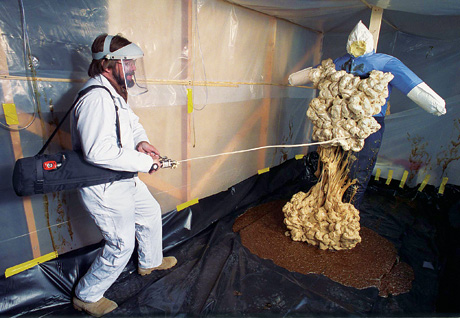
Why, speculated the Deputy, could not the technology be developed for a "gloop gun" which would ensnare the violent criminal in sticky goo, and prevent them from hurting anyone?

The obvious answer is that Spiderman is a fictional character, and his spider web does not exist in the real world. But apparently something rather like a "gloop gun" does exist - my thanks to Dave Rotherham for pointing it out. Wikipedia noted that:

"Sticky foam is an incapacitant, used when less lethal force is required, consisting of various extremely tacky and/or tenacious materials carried in compressed form with a propellant and used to block, entangle, and impair individuals. A National Institute of Justice-funded project at Sandia National Laboratory developed a "gun" which could fire multiple shots of sticky foam."

However, there is a fly in the ointment (an appropriate cliché where Spiderman is cited!):

"Problems with this technology include: the serious risk of smothering (suffocating) the subject; skin clean-up (the foam may not be toxic, but solvents are often harsh); "gun" clogging; targeting and firing; and gun cleaning."

A photo of deployment can be seen at the end of this blog.

In fact, it is not nearly as simple to deploy as Spiderman's web gun, which is perhaps not surprising because that is, after all, science fiction. Here's a description:

"The image of soldiers blasting away with soapy-looking foam instead of using riot batons was almost quaint. With the foam stored in silver cylinders mounted on backpacks, the sticky foam gun had a kind of campy James Bond jetpack look to it, like something from the future, if your present is, say, 1958."

"After a person has been immobilized, the sticky foam, which is made out of rubbers, resins, oils, and flame retardants, can be removed, eventually, with hard scrubbing and baby oil."(4)

The official tests have this to say:

a) sticky foam adheres immediately to skin,
b) mineral oil (baby oil) is a reasonable cleaner for removing sticky foam from skin,
c) Using mineral oil to remove sticky foam from skin requires significant mechanical effort (5)

Its deployment was not perfect; some physical force was also needed to subdue people after the sticky foam was used, and there was a potential suffocation risk

There seemed however to be no indication that Deputy Duhamel was aware of the problems with sticky foam when he was eulogising about his "gloop gun".

I sometimes get the feeling that the good Deputy has some good ideas, but he never quite manages to subject them to critical thinking before unleashing them on the general public.


No, the bearded holder of the gloop gun is NOT Deputy Duhamel!

Links
(1)   http://jerseyeveningpost.com/news/2014/04/08/fantasy-film-may-not-start-this-summer/
(2)   https://www.jersey.com/English/sightsandactivities/eventscalendar/Pages/Event.aspx?AttractionID=7987
(3)   http://en.wikipedia.org/wiki/Sticky_foam
(4)   http://cabinetmagazine.org/issues/22/mcweeny.php
(5)   http://www.aquafoam.com/papers/Scott1.pdf
(6) http://cabinetmagazine.org/issues/22/STICKY-FOAM-1_v2.jpg

Tuesday, 8 April 2014

Posting about the Past


The building above was once the HQ of the Jersey Evening Post on Bath Street, and later briefly, where Income Tax was before they relocated to Cyril Le Marquand House.

But the photo, while it looks old, is actually modern, taken this month. I've been collecting photos of St Helier buildings, especially offices and shop fronts, as a visual record of what the Town looked like in the second decade of this century.

I was enjoying an App on Kindle, which enables one to manipulate photos, and came up with this rendering, a sepia shade, with a grainy texture, but it was not an attempt to deceive anyone, just myself having a bit of creative fun.

However, looking old, as it did, brought back many memories for some of those posting comments on Facebook, and they are, I think, well worth sharing. I have made them anonymous, by removing surnames. They are fascinating little anecdotes of the past. 

Andrew: My dad was a graphic artist at the JEP for many years - in the corner of his studio behind his chair was a door that opened onto the mechanism running the clock visible on the outside of Charles House ~ mesmerising for a young boy. This was also the cupboard where "Uncle Harry" of the Junior Club kept his prizes. Loved watching the liquid metal being poured by the typesetters too. Memories... 

Denise: I remember this building as well, further up on the left hand side of this picture was a big wooden door and at the back of this area was an old wooden staircase which took you right up to the top of the building where the photographic department was. I used to run up these stairs regularly after school at Halkett Place to see my dad who was one of the JEP photographers. 

Andrew: I ran up those stairs after school too. Dad finished work at lunchtime on Thursdays & went in on Saturday morning. There was a cinema very close too 

Christine: I used to work there sending out the weekly post. I remember when Bunty Wagstaff announced to the staff his engagement to Daphne !!! Fond memories of Terry Mercury who was a proof reader back in the 70's.    

Monday, 7 April 2014

Energy Visions of the Future

"Minister's vision: Buy your own wind turbines. Islanders should adopt a Scandinavian approach to power by forming small energy communities and buying wind turbines and patches of roof-top solar panels, the Environment Minister says."
 
"The ambitious plans, Deputy Duhamel said, could see 1,000 households or more joining together to buy a wind turbine to power their homes, freeing them from the energy costs of a single mainstream supplier."(1)
 
The Jersey Evening Post reported on this story earlier this week, and I took a look at a couple of publications on the topic.
 
Ian Woofenden has written a book on "Wind Power for Dummies", and while it in theory allows someone to set up their own wind turbine, it also gives a good idea of the scale of the problem. Apart from the wind generator, the tower, wire and associated equipment for transmission and batteries for temporary storage, there are also a grid interface, metering, disconnects, overcurrent protection, grounding a more to ensure the system is safe. As he noted "There's a lot of detail to understand here, and unless you already have experience under your belt, you need support in this realm."
 
And he says "Wind energy is not a build-it-and-walk-away proposition. These systems require regular maintenance. At least once a year - and maybe twice - someone needs to lower or climb the tower to check the wind generator, do all scheduled maintenance, and address any problems. On the ground, batteries are the primary focus for maintenance, but you need to be aware of other system components and their calibration, too."
 
He explains clearly why this is the case. "Turbines live in a very harsh environment, high above the ground, where they're punished by very strong and variable winds. Turbines are rotating machines that spin, sometimes at very high speeds. Where you have mechanical motion, you'll have wear and tear". Higher than average wind speeds will increase the wear and tear, and exceptionally high wind speeds can potentially damage the turbine, as was seen on television a few years ago, when the turbine caught fire.
 
I have also been perusing a copy of "Home Power" magazine, which also looks at maintenance - "never buy a turbine solely on its up-front cost, but rather on what it will cost you over the long haul - money, time and aggravation. Wind electric systems are the toughest renewable energy systems to maintain, with the highest failure rate. Why? Because wind turbines live in a brutal environment atop 80 to 120 foot towers not readily accessible if you don't climb."
 
While small energy communities may be found in Scandinavia, where there are relatively remote clusters of dwellings for which wind power may be more suitable, Mr Woofenden comments that this is not true of all locations - "There are places where wind-electric systems just do not make that much sense - densely populated urban and suburban areas are not a great choice" Taking a map of Jersey, I would imagine that the more urban parishes would largely be ruled out.
 
And in more general matters, my correspondent Adam Gardiner had this to say:
 
"Facts and costings seem to be in short supply with the Minister's suggestion. For a start, the costs are significant --we are talking hundreds of thousands of pounds to set up a system to generate a 240volt supply. But also it should be noted that these will require qualified specialist electrical engineers and to install and maintain them."
 
"And there are other problems. What about your problems if you wish to move out from your "energy community". This raises all kinds of legal issues which have not been considered. As well as this, a prospective buyer of a property could be told they are locked into some sort of energy deal which the property is rigged up to. This could lead to all kinds of problems with property sales, especially if there are rising maintenance costs after the turbines have been in place for some years."
 
"Then there are the obvious and endless complaints. There could well be grounds for nuisance, both because of the noise, and also the visual aspect. Planning consent would be needed which at the present time precludes such a construction by virtue of the Island Plan."
 
"Who would oversee such work as to assure that a 240volt supply complied with the standards required? A vision of the future energy needs? I rather think the good Deputy should go to Specsavers!"
 
"Affordable and viable energy for Jersey is an island issue and best left in the hands of those who provide our energy needs at present as that have the expertise - and the network. That is not to say that the JEC should not be pursuing a policy of exploring our natural resources that could make Jersey more self-sufficient in the future. I should be surprised if they are not. That the States are encouraging this seems to be in some doubt. The impetus provided by the late Constable Dan Murphy seems to have ceased."
 
"But what seems to be the worst case scenario would be wind-turbines springing up ad-hoc all over the island at the expense of both the visual landscape and the ability for the JEC to invest in future technology to the benefit of the common good of us all"
 
"For my money, given we are surrounded by water and experience some of the highest tidal ranges in the world, energy from the sea seems to be the most practical and sustainable solution. I am sure it's not the cheapest option but is clearly the most reliable."
 
One thing that does come from reading Ian Woofenden's book is that Deputy Duhamel's second suggestion on solar panels may be the more viable one. It is a shame that the Jersey Evening Post's focus, concentrates on the wind power, which seems a very costly option. I noticed that in the politics hour on BBC Radio Jersey, or at least the portion I heard while driving, the Deputy was concentrating on solar panels, which was much more feasible.
 
Mr Woofenden notes that:
 
"In my 25 years of using wind and solar electricity, my PV modules have just sat on the roof doing their job. I wash them a few times a year, but other than that, I've had no involvement. In the same time period, I've had multiple wind generator failures, and my machines have all needed regular maintenance."
 
"Another bonus: Besides being simpler and more reliable, solar-electric systems are more modular than wind-electric systems. Expanding as your interest or budget allows is relatively easy (though some planning ahead is advisable if you think growth will be in your future)."
 
And he also notes that solar panels have a much wider scope in terms of placement:
 
"Many, many more people have a good solar site than have a good wind site. PVs can go on roofs, poles, and ground mounts in the city, suburbs, or wherever. Good solar sites have clear access to full sun all day, or at least for the peak hours of 9 a.m. to 3 p.m. Though not all sites have good exposure, I'd say that for every good wind site I look at, I probably look at 40 or 50 good solar sites."
 
The National Renewable Energy Laboratory in the USA provides provide monthly average daily total solar resource information on grid cells for the country.
http://www.nrel.gov/gis/solar.html  
 
And the UK Met Office does the same (albeit on a smaller scale) for the UK
http://www.metoffice.gov.uk/renewables/solar  
 
If Deputy Duhamel's vision is to be a reality, at least for solar energy, then a helpful precursor would surely be to determine which areas in Jersey would be viable.
 
There is at least one company into solar energy in the Channel Islands, the Little Green Energy Company, and their testimonials are promising.
http://littlegreenenergy.gg
http://www.littlegreenenergy.gg/Customer_Testimonials.htm
 
While solar energy is not likely to completely replace grid power, it seems to be a more viable option than wind power. It is less noisy. It may cost, but it requires far less maintenance. Perhaps there is room for at least part of Deputy Rob Duhamel's vision, after all.
 
But it would also be good to know who is now taking on the mantle of the late Constable Dan Murphy in the States in progressing work on the viability of wave power. There is no need to have all the renewable energy eggs in one basket.
 
References
(1)   http://jerseyeveningpost.com/news/2014/03/31/ministers-vision-buy-your-own-wind-turbines  
(2)   Wind Power for Dummies, 2009, Ian Woofenden
(3)   Home Power Magazine, Jan 08, Issue 122

Sunday, 6 April 2014

Fragile Life

Today at St Brelade's Church, there was a new Christening bowl dedicated at the family service; it is a gift from a family who lost their young child, age 3. There can be few things as sad as the death of a small child.

I have been to one funeral which was a cot death, of a boy a few months old. Another of a child who died of a heart condition, again only a few months old. My abiding memory is of the latter, of the father, quite a large man, cradling this tiny coffin in his arms as he processed slowly down the aisle at St Peter's Church. I can picture that still; etched on my brain.

The fragility of life came up briefly as a topic of conversation at a breakfast at St Peter's Garden Centre which I attended on Saturday. We tend to put death to the back of our minds; we probably could not function if it was there all the time.

But sometimes, we do need to be reminded. The fragility of life reminds us of how precious it is, of how each moment might be our last. Just as we cannot live in a state of euphoria or a state of despair all the time, we can't live with that knowledge either. But the danger is that we don't live with it at all; we live our lives as if we never have to come to terms with death. When Annie, my partner, died, it was the first time I had seen anyone dead. And I suspect my experience, in that regard, is not that uncommon.

Death is sanitised nowadays, and unless you want to, you don't have to see dead people. The funeral directors take care of all that for you. It is something which didn't happen in the past, where death was much more of a part of life. There's a grave with a small statue of a young boy in St Brelade's cemetery. He died around Christmas in the early 20th century, aged 10. Infant mortalitywas high, as family trees show, and death was not as taboo as it has become.

The poet Langston Hughes captures the modern attitude of shutting out death very well:

"Life is for the living.
Death is for the dead.
Let life be like music.
And death a note unsaid."

Intimations of mortality begin when your peers begin to die. My oldest school friend, from the 1960s and early 1970s, was Nigel Miles, and he must have died in the 1980s; I can't remember precisely when. I remember the funeral; it was at St Brelade's Church, and quite packed, and pouring with rain outside. Of course, not only were friends and family there, there were friends of his parents there in support as well. He must have been in his 20s when he died. He died of Aids, and of course, back in the 1980s there was a degree of stigma attached to that. Even some clergy, who should have known better, made misguided remarks about divine retribution; thankfully, none of that was present at his funeral.

There's a James Bond film on today, one of the lesser Roger Moore ones, when he was rather too old for the part of a dashing young spy. The title is "You only live twice", and in the original book by Ian Fleming, it actually has something to say about the human condition:

"You only live twice:
Once when you're born
And once when you look death in the face."

That captures something of the way in which the fragility of life can be enhanced by experiences of death, either our own, or someone close to us. As so many people have said, going to the brink of a life threatening illness, or a near fatal injury, can cause us to reassess our lives, and realise just how rich and precious life is.  As Victor Hugo says, in Les Miserables:

"It is nothing to die. It is frightful not to live."

Saturday, 5 April 2014

Weather Report

BBC News - "People with health problems are being warned to avoid strenuous activity after forecasts that air pollution will reach high levels in parts of England.  Defra issued warnings as high pollution levels were recorded on Tuesday. The pollution - a mix of local and European emissions and dust from the Sahara - is forecast in parts of south England, the Midlands and East Anglia. The pollution has caused a thick layer of dust to form on cars and buildings The elderly and those with lung or heart disease are among those warned against exercising outside."

And here is my poem about it:

Weather Report
 
Evening pink of Saharan dust
Winds carrying the sand along
Falling on the cars, leaving a crust
A fragment of a desert song
 
Breath with care, beware the dust
Its fine particles inhaled in lungs
From Southern lands, in sudden gust
Like Djinn's spell in foreign tongues
 
The smog returns to London town
Across the Thames, above Big Ben
As the desert dust is settling down
Over St Paul's Cathedral in amen
 
The weather report is a smog alert
As air pollution may well hurt

Friday, 4 April 2014

Independent Jersey Care Inquiry: A Note on the Preliminary Hearing

The Committee of Inquiry website is at:
http://www.jerseycareinquiry.org

Other blogs online commenting on it are:

Rico Sorda
http://ricosorda.blogspot.com/2014/04/committee-of-enquiry-decades-of-child.html

Former Deputy, Bob Hill:
http://bobhilljersey.blogspot.com/2014/04/independent-jersey-care-inquiry.html

Neil Macmurray
http://voiceforchildren.blogspot.com/2014/04/francis-oldham-qc-transcript.html

Laying the Foundations

I shall be reviewing the inquiry as it unfolds, but at present what has been laid out is a lot of groundwork – the foundations, upon which the inquiry evidence and assessment can be built upon. It is a good start. Once we begin to see transcripts and material appearing, we'll have a much better idea as to how detailed it will be, and how solid those foundations are. But they look very good.

And certainly the terms of reference are very wide ranging, as are the powers of the inquiry to call people before them, and obtain evidence.

First Stage: Victim's Testimony

The first stage of the inquiry is quite rightly collecting witness statements, and these are the stories which need to be told, if the victims of abuse are ever to obtain some degree of closure. Of course, like grief, closure is never complete, but knowing that your personal history of abuse is not being ignored but listened to is an important part of the healing process.

In that connection, it is important that there is adequate provision for counselling if required, as giving evidence can be an extremely traumatic experience. In the Northern Ireland inquiry, there has been criticism of "the lack of face-to-face counselling provided for those who have come forward to tell their stories," and the BBC reported that "some witnesses have been suicidal after giving testimony"

It is a shame that there does not appear, as yet, to be any links or information regarding counselling and its availability available on the Jersey inquiry website. Perhaps that can be addressed as the inquiry develops.

Phase 2: Looking at the History and Aftermath of Operation Rectangle

Looking ahead to Phase 2 of the Inquiry, I noticed this in the opening address by Frances Oldham, QC:

"We will be asking ourselves whether the policies and procedures of those organisations were fit for purpose at the time. We will also consider whether appropriate decisions were taken in deciding whether to prosecute individuals and whether there was political or other interference in those decisions."

One thing of note is "at the time". The law had not been changed in 2008 to enable the judge to abolish the rules governing evidence:

"The Bailiff or a Commissioner in the Royal Court, in a case where evidence has been given by any of the above, must always, when summing up to a jury, warn them that it is dangerous to convict if that evidence has not been corroborated in some way."

The law had been changed in the UK to allow the judge discretion over giving this warning. But in Jersey, it remained mandatory.

According to reports in the JEP, it was a conflict within the Council of Ministers over this which caused Senator Wendy Kinnard to resign as Home Affairs Minister because she wanted Jersey to move to the UK discretionary rule. Under Frank Walker's tenure as Chief Minister, the Council of Ministers actually refused to discuss this change.

That was certainly a grave error of judgement, and it almost certainly would have meant that the judgement on whether or not to prosecute was unfairly biased against a presumption to prosecute - when there was only one witness, and the rules applied.

That was changed by Senator Ian Le Marquand when he introduced the Criminal Justice (Miscellaneous Provisions) (No.3) (Jersey) Law as Home Affairs Minister, which came in March 2012, long after the cases of historical abuse had gone to court, or been judged unlikely to succeed. As Senator Le Marquand told the States:

"I am not sure that I can give Deputy Le Hérissier any specific information about the number of cases which have led to convictions in other jurisdictions as a result of the changes in the corroboration rules, but logic would suggest that the absence of the requirement for corroboration has made it easier to bring guilty men to justice and I cannot, I am afraid, say more than that."

Clearly the policy regarding this rule was lagging extremely far behind the UK, and even behind the Isle of Man – introduced 2001 – and Guernsey – introduced 2002. Why it had remained unchanged is unknown – a lack of urgency could have led to its being given low priority -  but it is almost certain that it was the increased likelihood of cases in 2008 to which it would apply was the reason why Senator Wendy Kinnard sought to have it rescinded.

We know from Senator Kinnard's resignation statement that she was attempting to bring this change in the law, and that it was thwarted. No attempt was made after her resignation to bring forward the change, under Deputy Andrew Lewis as Minister for Home Affairs. Inaction is less noticeable than action, but it can cause injustices to remain fixed in judicial systems.

Why the Council of Ministers, and in particular, the Chief Minister, were opposed to this change can only be a matter of speculation, and it is certainly a matter upon which they could be summoned and questioned. I am not going to put words in their mouths, rather they should be called upon to account for their deliberate policy of inaction, and explain themselves.

As John Stuart Mill said: "A person may cause evil to others not only by his actions but by his inaction, and in either case he is justly accountable to them for the injury."

As things stand in the historical record, what can be said is this - this deliberate inaction did amount to political interference in the judicial process. It was not a direct interference, but it was significant second order interference.

By delaying any change in the rules, it meant that it was a higher bar to decide whether to prosecute. Ian Le Marquand himself noted that "logic would suggest that the absence of the requirement for corroboration has made it easier to bring guilty men to justice." Conversely, the requirement would have made it harder to bring guilty men to justice.

Frances Oldham said in her presentation:

"The second part, to be heard in Phase 2 of the Inquiry, asks us to 'review the actions' of government departments, the justice system and elected representatives following the start of the investigation into allegations of abuse at Haut de La Garenne in 2007. We want to hear from the Ministers for Home Affairs and for Health and Social Services at the relevant time and from the Attorney General's office. Their evidence will assist us particularly in relation to the assessment that we must make of the lessons to be learnt."

It seem to me, just from the historical record, that there are certainly questions to be asked, and actions – or rather deliberate lack of action – to be reviewed.

In this context, the words Winston Churchill are appropriate on the lack of action on changing the rules until too late in the day: "Want of foresight, unwillingness to act when action would be simple and effective, lack of clear thinking, confusion of counsel until the emergency comes, until self-preservation strikes its jarring gong - these are the features which constitute the endless repetition of history."


Thursday, 3 April 2014

Limericks from Correspondents

By way of something light-hearted, here are some more limericks on local politics; these are ones that have been sent to me. I've tried to filter out what I consider unacceptable for the lightness of touch I wanted. One I did not understand in the slightest, and a few others I thought were too close to personal attacks on politicians or ex-politicians.
 
Ian Orchard gave me this one
 
Sir Pip took electoral reform
To referenda, which he hoped would transform,
The way we elect, but the only effect,
Was a turnout that was barely lukewarm.
 
Daniel Baugh followed this up:
 
There was a referendum you see
The public did vote option B
But the people in power
Were bitter and sour
And on reform, they could not agree.
 
Darius Pearce gave this one, also on the Referendum:
 
The people of Jersey they informed,
Their states, they were to be reformed
The members deranged,
decided no change
To our wishes they never have conformed
 
Ian Orchard emailed me these further ones:
 
Young Sam had designs of the States
Which despite of his lefty wing traits
Came top of the poll,
And came off of the dole
To join with the mob he berates
 
An environment minister called Rob
Has said it is part of his job
To approve bricks and mortar
For a new finance quarter
This proving himself such a nob!
 
A Minister known as Ringbinder
Backed a film he considered a blinder
But two-hundred k
Was just frittered away
Come October he'll need a reminder
 
A Treasury Minister called Phil
Gets some sort of curious thrill
Outa raising our taxes
Yet our benefits axes
Thus reducing our income to nil.
 
And this one which he sent is just a plain silly sort, but we need those too!
 
Montfort's an interesting name
And Tadier's also the same
But when put together,
One's not sure of whether
If the parents are really to blame!
(boom, boom!)
 
Daniel Baugh also sent me this one, which has a nice touch of surrealism in the fourth line
 
The lefties want things to move forward
But their policies are a little bit awkward
Political parties,
Legalise smarties
And fight until Bailhache is cornered
 
Charlie Townsend sent these four in:
 
When the Tourism Shadow Board met
They decided Jersey Tourism was wet
Tourists with buckets and spades
Creak on now with hearing aids
That market is gone for good, I'll bet
 
An Education Minister was all of a dither
And his policies seemed just to slither
On a new Quennevais School
He never laid down a rule
His plans just seemed to vanish and wither
 
There was once a Bishop called Tim
Who issued a report on a whim
Caused trouble for Bob Key
And the lady called HG
You'll never find that in a hymn!
 
A Prison Visitor told a story to the Mail
Of how she had sex in a jail
She got lots of dosh
But was it all tosh?
And just a fund raising tall tale?
 
So there we have it. Apologies for those I missed out.  I hope this raised a smile or two, even among those who were the subjects of the limericks. And what I want to know is - when will they legalise smarties? I hear they are currently banned as a "Class B Sweet".

Wednesday, 2 April 2014

There was once a States member called...

By way of something light-hearted, I have compiled a few limericks on local politics and politicians. I hope the readers find that these poke gentle fun at local politicians, and also some of the people involved in local politics.

There was a Chief Minister called Gorst
Who thought things could not get any worst
When planning did stray
But the Minister did stay
Then he thought, with that man I am cursed!

The Constable of St John was in a flurry
And exclaimed about fields full of slurry
They've polluted the water
And they really ought not to
So let's have main drains now in a hurry

Philip Ozouf made a fuss over street naming
"Non, non, non", he muttered, exclaiming
Saying that "La Rue a Don"
Should have the "La" gone
And for once, he is doing the blaming!

A BBC presenter called Price
Could be very pleasant and nice
Then like Jeremy Paxman
He became like an axe man
A lesson to politicians to think twice!

There was a bearded Minister of Planning
Thought to moving where airplanes landing
But to knock down a church spire
Was deemed terribly dire
And the idea came in for a panning.

A new law came out upon treason
Suddenly, without rhyme or reason
They said it would clear
An anomaly there
Coming early is the silly season!

A would be politician called Risoli
Said all we needed was transparency
He always said this
But votes he did miss
And his election prospects were lowly

Ron Duhamel spoke about wind power
On and on, he droned for an hour
And when he was done
Sarah Ferguson reached for her gun
And we watched the scared Deputy cower

Apologies to Rob Duhamel for the way in which he keeps cropping up, but his ideas do seem tailor made for comedy. And, just in case anyone asks, I do not believe Sarah Ferguson has got a gun, but it does make for rather a nice touch of surrealism. But I do know she's not too keen on wind power, and she's confirmed that to me.

Tomorrow I will be posting contributions which I have been sent from other people.

Tuesday, 1 April 2014

Parish plug shortfall Solution to avoid drain on municipal resources

Parish plug shortfall Solution to avoid drain on municipal resources
by Guest Blogger, Pauline Legge

The harbour at St Aubin's is full of boats once more, now that dredging operations have been completed. The sharp-eyed viewer may notice that the harbour, when full at high tide, now remains one yard below its previous high water mark. .

In a leaked report, I have learned that in the course of dredging the mud away, some historic damage to the harbour floor was uncovered. Older members of St Aubin's community may remember that here is a vast circular cast iron plug, about 3 yards in diameter, which was made to keep extra water in the harbour to enable larger boats to moor. This appears to have been damaged at some time in the past.

The first plug was made of solid oak in Elizabethan times, when Sir Walter Raleigh deemed "forsooth the waters should be retained, privy for the berth of larger vessels of trade". The money was raised by a levy on the rates. In Victorian times, the oak was badly rotting, and the Connétable stated that "des centaines de livres sont parties en fumée". A cast iron plug was made to replace it, by ironmongers, again financed by the rates.

Repairs to this plug are therefore needed, and a special early assembly of the Parish is planned for today,. April 1st,  to levy an emergency increase on the Parish rates of 1p to pay for it. After the assembly, which will be held at 11 am, there will be a traditional fish breakfast of "poisson d'avril".